

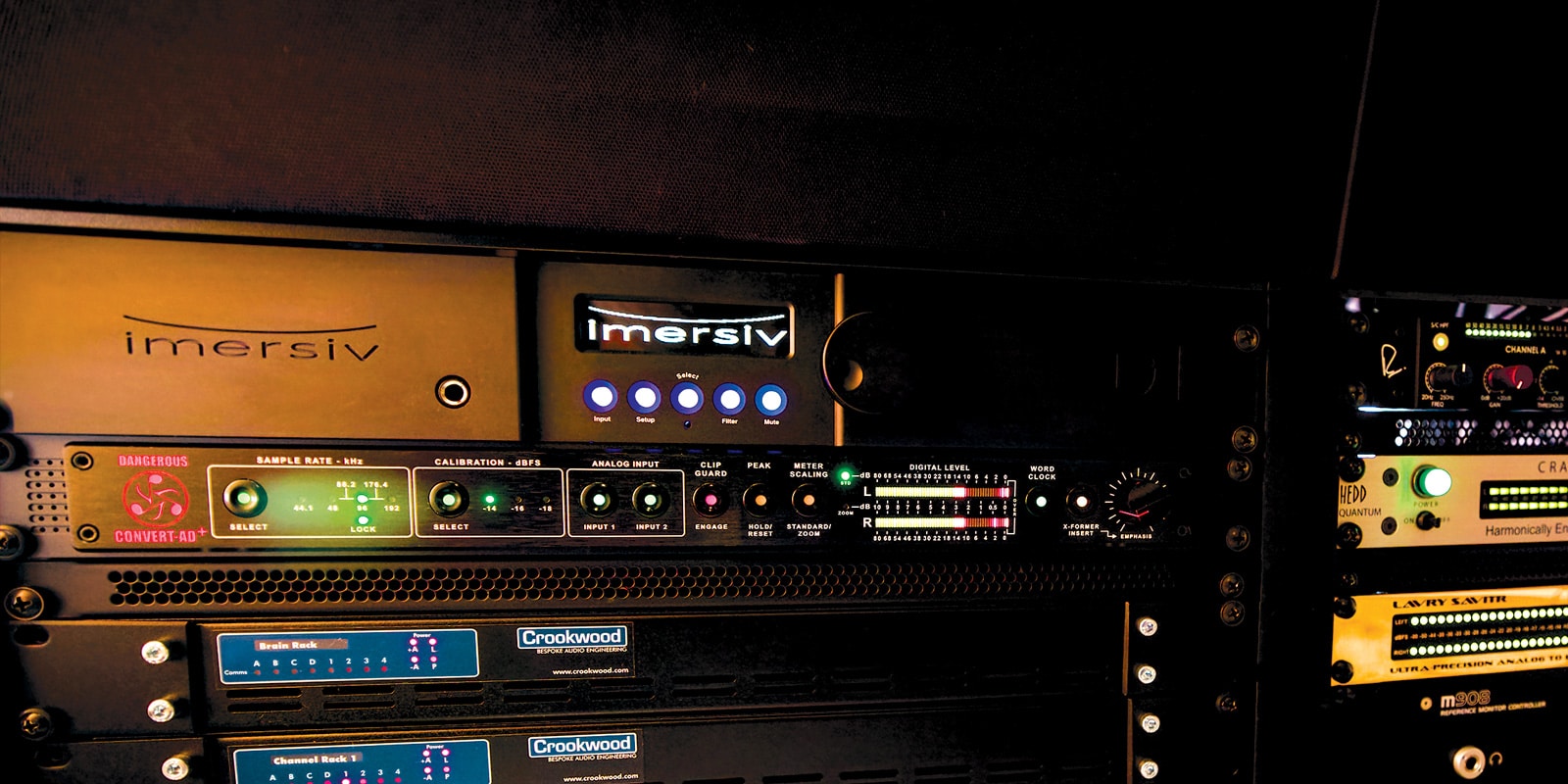
Is this next-generation audio?
Review by Paul Vnuk Jr.
Imersiv is a new subsidiary of Millennia Media—created to spotlight new cutting-edge designs from company founder John La Grou. The company’s first release is the D-1 DAC, described as a high dynamic range, multi-path digital-to-analog converter.
Are We There Yet?
Many of us in the industry believe that digital audio conversion has mostly plateaued. Even modest converter designs can no longer be blamed for poor-sounding recordings. Before you get ready to “put me on blast,” especially the audiophiles among us, I‘m not claiming that all digital audio converters sound the same, or that you might not prefer one to another. I definitely have my favorites based on my perception of their sonic nuances.
Generally, the converters in most current audio interfaces, ADCs, and DACs use one of four chips—ESS Sabre, AKM Velvet Sound, Cirrus Logic and/or Burr-Brown. The “sound” you perceive as different, better or worse depends on how a company chooses to implement that chip in its converter design and what else is in its signal path. Yes, I am oversimplifying, but only slightly.
So, to summarize, we are good now. Converter technology is maxed out, and we can focus on other things…
It turns out John La Grou disagrees and has spent more than a decade working to redefine not only audio conversion but the entire audio signal path. Yes, it might sound a bit like lofty marketing hype and even slightly arrogant, but what if it‘s true?
Here, “Hold my DAC.”
Reviews
- October 2026: Chandler Limited REDD Mixing System
- September 2026: Barefoot Sound Footprint 01 Gen 02 and Footprint 02 Gen 02
- iamReverb
- August 2026: Focusrite ISA C8X
- July 2026: JZ Microphones MU-1
- Fender Quantum LT 16 USB-C Audio Interface
- LANDR: An all-in-one music ecosystem
- June 2026: Strymon NightSky Experimental Reverb Plugin
- May 2026: Sennheiser HD 480 PRO
- Neumann Rime
Two Audio Paths, No Waiting
I should mention that I can’t cover every technical detail of the Imersiv D-1 DAC’s inner workings here. If you’re interested in the technical specifics, check out the company‘s website, where you can take a really deep dive.
The D-1 DAC is a high dynamic range audio device (HDR-A®). John likens this to HDR photography (see sidebar #2). Just as multiple stacked digital exposures enhance the detail in a photograph when combined into a single image, John applies this same idea to digital audio with a process he calls multi-path audio conversion, which divides the audio into low- and high-level signal paths.
It‘s important to clarify here, since I initially misunderstood this concept. The high- and low-level audio paths are defined by their levels, measured in decibels. The D-1 DAC is not a multi-band process that divides signals into low- and high-frequency bands.
In simplified terms, the audio stream is broken into signals falling within the low range of 0 to 100dB and high-range signals of 100dB to 170dB. This gives the D-1 DAC a recombined, impressive 0 to 170dB (not a typo) of dynamic range, and according to John, “self-noise that cannot be measured and atmospheric levels of THD+N that can be orders of magnitude lower than conventional DACs.”
What this promises is greater clarity and detail, especially in low-level content, than any other converter or even audio device on the planet.
Meet the D-1 DAC
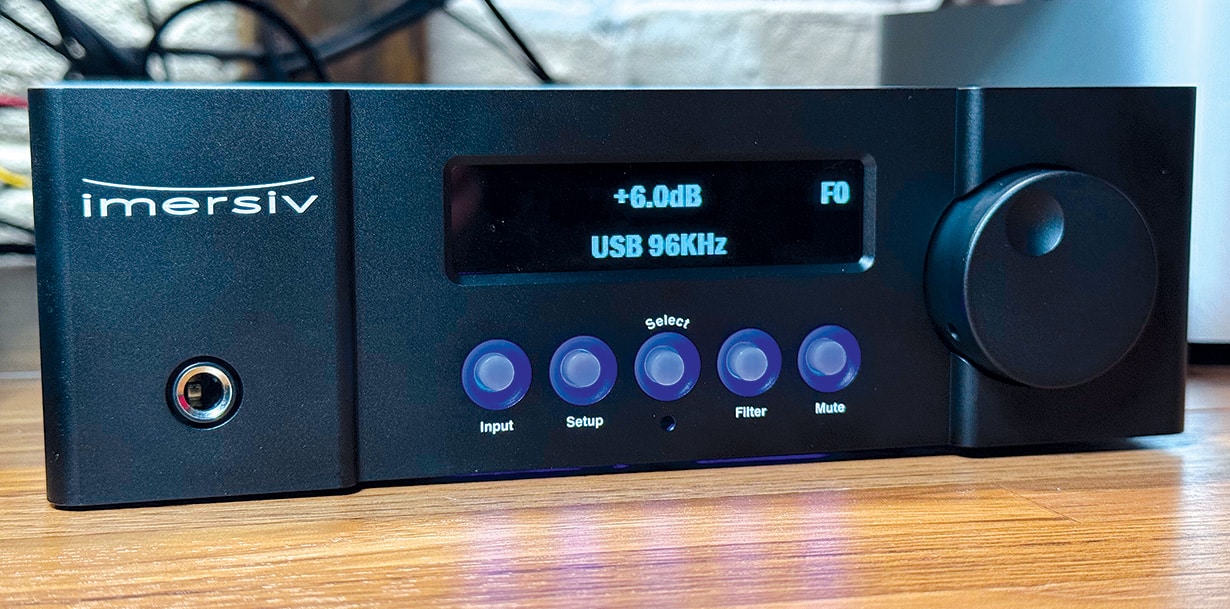
The D-1 DAC is a 1.5U-high device that can be purchased as a full 19″ rack-mounted device or as a half-rack desktop unit with a black or white thick metal faceplate. A four-channel model is available as well.
The front of the unit centers on a 2-line LCD alphanumeric display with five backlit function buttons labeled: Input, Setup, Select (akin to the enter key), Filter and Mute. Next to that is a super high-quality rotary encoder, which can adjust menu functions, but defaults to the unit’s -130dB to +24dB master level control. There is also a front-side 1/4” headphone jack.
Around Back
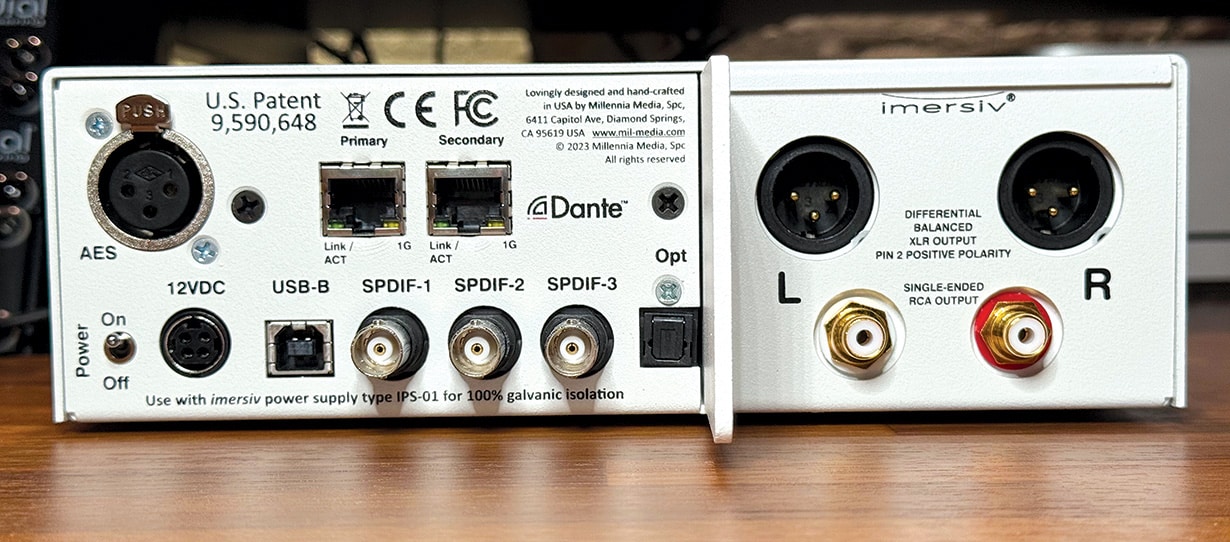
On the rear of the unit, you will find two sides divided by a thick protruding metal plate. The digital side offers inputs for AES over XLR, Dante (optional), a trio of BNC-based SPDIF inputs, a single ADAT optical socket and USB-B. There is also a multi-pin 12V DC input for use with an external power supply and a master power switch.
On the analog output side are stereo (L/R) balanced XLR and unbalanced, single-ended RCA outputs.
Connection Caveats
There are some interesting points to note about the three analog output options on the D-1 DAC. First, the only way to utilize the multipath architecture is with the XLR outputs, according to the company, because “multi-path topology is inherently differential and balanced..” The phono outs and headphone output, while still offering high-quality conversion, are not multi-path. It’s also worth noting that the XLR and phono outs cannot be used at the same time. The headphone outs are switchable to mute the main signal as needed.
Functions
Functions are accessed by the front panel buttons or, better yet, with an included remote control. This includes I/O routing options, level setting, digital source selection and even the ability to choose between six digital filter options.
The D-1 DAC has a self-calibration feature that should be run whenever you change the output connections. It’s simple and takes less than a minute.
Sound and Use
So, is the Imersiv D-1 DAC the paradigm-shifting, sonic game-changer that it claims to be?
To my ears, in both my home listening room, as well as in my professional mix room, “abso-freaking-lutely.” I compared the D-1 DAC to six other well-respected (and great-sounding) top-line converters, and music played back through the D-1 DAC exhibited notable sonic differences across the board.
There was greater detail to be found in string plucks and strums, bowing on strings, finger taps, stick hits on cymbals and drum heads, and vocal nuances.
There was also an improvement in the depth and spatial cues in the music. It was like I could aurally “see” deeper into the soundstage. While we often associate clarity with high frequencies, this added detail also extends to the low end, which, across the board, sounded more defined as well.
The biggest shock to me was that 16-bit CD audio sounds better through the D-1 DAC, let alone hi-res and DSD files (which the D-1 can accommodate).
In addition to USB, the inclusion of Dante allowed me to easily integrate the unit into my mixing room, which let me take advantage of the increased detail when mixing my last two projects. The extended low-level detail found in the D-1 DAC was especially apparent in the clarity of reverb tails and room mics.
A Few Things to Note
There are a few things to note about the D-1 DAC. Dante input, a balanced (4.4mm) headphone amplifier, and the 19″ rack mount configuration are factory-installed options and must be ordered accordingly. Firmware must be updated at the factory, if required.
Next, as is often the case with cutting-edge advances, the Imersiv D-1 DAC is a sobering $12,000. Think of the D-1 DAC like you would a concept car. You may not be able to afford the first-generation item, but pieces like this need to happen to push the sonic needle forward. Someday, who knows, maybe the audio in your smartphone will come stock with HDR-A, multi-path technology.
Bottom Line
The Imersiv D-1 DAC is a mind-blowingly great-sounding piece of kit that, unlike many audiophile “accoutrements and devices,” actually delivers on its concept and promises. Hats off to John and the team!
Price: $12,000
More From: imersiv.com
A Second Opinion from Mastering Engineer Justin Perkins
I will admit, when I was offered the chance to test and review this unit, I initially declined. I already had three mastering-grade DAC options, not to mention my mastering speakers have an internal DAC that is part of the crossover and amplification mechanism and can’t be bypassed.
However, after hearing a few noteworthy opinions about it from other mastering engineers I trust, I decided to give it a try.
As Paul mentioned in his review, I was simply of the opinion that we have essentially reached peak-quality with DACs, and anything remotely mastering-grade built in the last few years is already WAY better than what we had prior.
But even if that is true, I have now learned that there are still gains to be made in the DAC department, if you want them.
In the Mystery Room
I’m lucky to have a mastering console that allows me to simultaneously feed three DACs that can be chosen to feed my analog processing chain, and I can toggle them instantly for great A/B/C real-time comparison.
I was quite surprised by the level of detail and depth that I heard when I chose the D-1 DAC. I think the HDR photography analogy on the Imersiv website is pretty accurate. This unit is basically the HDR photography of DACs.
For the first week or two, I would compare the D-1 DAC to my other DAC options, but nine out of ten times, I would choose the D-1 DAC. Now, after a few months, I basically just leave it set to that unit and don*t even bother trying the other two options.
Hard to Describe
It’s so hard to describe audio in words, but this unit adds just the right amount of vibrance, clarity and detail to the audio that, in most cases, is really pleasing to the ear and complements the music. Again, I use it to feed my analog mastering chain, not for monitoring at the end of my chain.
On the other hand, occasionally I*ll be mastering something that is either intentionally (or unintentionally) lo-fi or not great-sounding, and fortunately or unfortunately, the D-1 DAC can highlight those unattractive things a bit too much.
Sadly, as mentioned, I can’t speak to this as a monitoring DAC, and while I’m sure it’s a great unit for listening to music, I have been very happy to have it as a tool for feeding my analog mastering chain.
I was concerned that it might impart too much character or other tonal shifts to the sound that I would later regret, but that has so far not been the case at all.