


And then there were three
Review By Paul Vnuk Jr.
The Lauten Audio Kick Mic is the newest entry in the company’s sonically intentional family of drum-focused microphones. Designed to capture the defining character of the bass drum, it joins the Snare Mic and Tom Mic, completing a trio of dedicated tools for the kit.
Past Featured Reviews
- October 2026: Chandler Limited REDD Mixing System
- September 2026: Barefoot Sound Footprint 01 Gen 02 and Footprint 02 Gen 02
- iamReverb
- August 2026: Focusrite ISA C8X
- July 2026: JZ Microphones MU-1
- Fender Quantum LT 16 USB-C Audio Interface
- LANDR: An all-in-one music ecosystem
- June 2026: Strymon NightSky Experimental Reverb Plugin
- May 2026: Sennheiser HD 480 PRO
All in the Family
This year marks 20 years since Lauten Audio released its first microphone, the LT-321 Horizon. Since then, the company has introduced 14 models across the Signature Series, Series Black, Synergy Series and its drum-focused line. None is designed as a clone or homage; each aims to deliver its own voice.
Drawing heavily from the look and technology of the Synergy Series, the Snare Mic (reviewed January 2024), the Tom Mic (October 2024), and the Kick Mic are the most purpose-driven designs in the catalog, each crafted to capture a specific part of the drum kit.
Kicking Up a Fuss
The Kick Mic shares the same body diameter, styling and controls as the Snare Mic and Tom Mic. Measuring 4.92″ by 1.97″, it sits between the two in height. It is an end-address design built around the fast single-diaphragm KC608 capsule. It operates as a cardioid condenser at higher frequencies and trends more hypercardioid around 50 Hz.
Controls
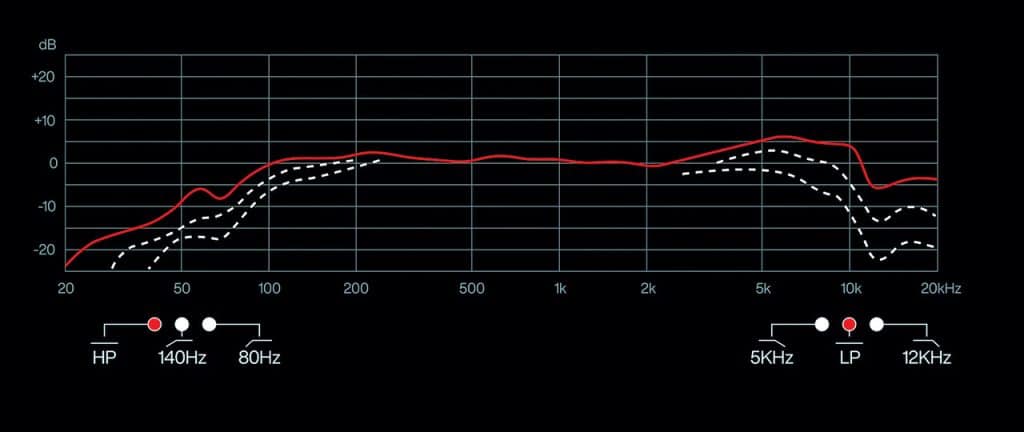
The Kick Mic features three-stage high-pass and low-pass filters, accessed via two 3-position toggle switches flanking the red inlaid Lauten crest. High-pass options are Flat, 140 Hz and 80 Hz; low-pass options are 5 kHz, Flat and 12 kHz.
The Kick Mic ships in a foam-lined, heavy-duty cardboard storage box and includes a locking swivel mount along with a durable Cordura zipper pouch.
Tones on Tap
While the Kick Mic offers a 20 Hz–20 kHz range, its frequency plot reads more like a classic dynamic mic: neutral through the mids, with a gentle low-end rolloff and a broad lift from 5–10 kHz. Unlike many other kick mics, it is not pre-shaped to flatter a kick drum. Rather, Lauten has voiced it neutrally so engineers can shape the tone with EQ and the onboard filters. In this sense, its a bit more like a classic non-kick-focused dynamic mic, with the added benefit of having the clarity, depth and reach of a good condenser mic.
In Place
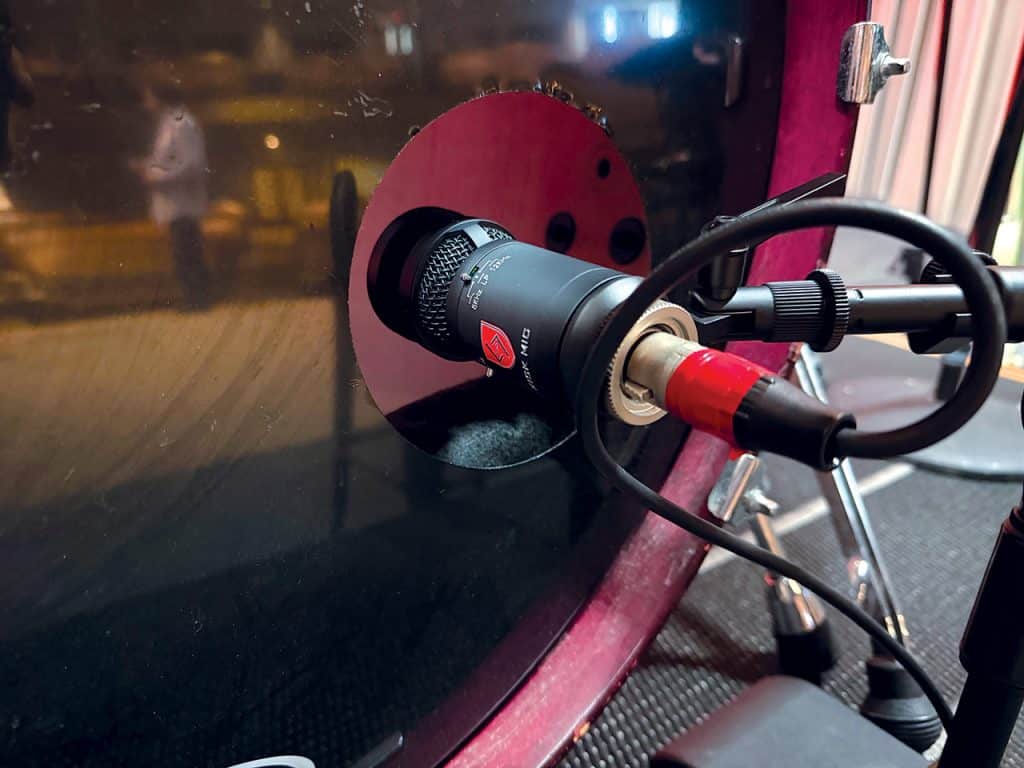
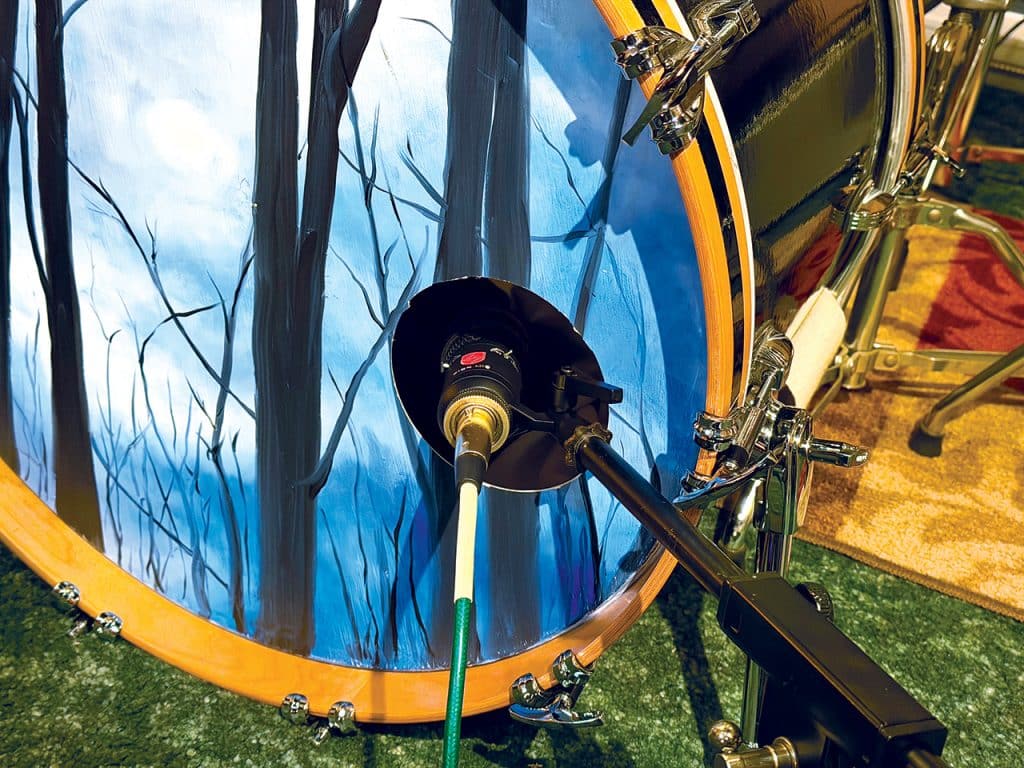
The Kick Mic is primarily intended for use inside a kick drum, whether positioned near the beater, placed within the sound hole or even semi-permanently mounted on an internal suspension cradle. If going the port-hole route, Lauten recommends placing the microphone so its control switches sit inside the opening as a minimum starting point.
I Get a Kick Out of You
To put the Kick Mic through its paces, I enlisted the help of session drummer and educator Dave Schoepke (Willy Porter, Martin Barre, Sundown47 and more), who also assisted me when I evaluated the Lauten Snare Mic.
My studio kit is a vintage 1966 Slingerland set with a 20″ jazz-tuned kick, and Dave brought over his 22″ and 26″ Ludwig kick drums. We spent an evening trying out the Kick Mic inside each drum in both beater and internal sound-hole positions. We also compared it with an Audix D6, a Shure BETA 52 and an AKG D112—all highly tailored kick mics with drastically varied tonalities. I can cut to the chase here and mention that the Lauten Kick Mic sounds like none of the above, although it can be EQ’d to exhibit qualities of each without necessarily copying them.
After our tests and some further practical use in the studio and on stage in a house of worship, I find the Kick Mic is closer in practice to modern open-ended, ultra-honest kick drum condensers offered by companies like DPA and Earthworks, but tempered with a weight and even warmth similar to classic dynamic non-kick mics like a Shure SM7B, Electro-Voice RE20 or beyerdynamic M88.
This can be summed up by saying the Lauten Kick Mic is designed to be open-ended enough to allow you great flexibility to craft your own kick sound, yet it starts out with enough flavor to keep it from being stark, clinical or unexciting.
In Use
What impressed both Dave and me was how much low-end the Kick Mic could reproduce—almost rivaling the impact of the D6, but while retaining the authentic tone of the drum. The top end is clear and dimensional, with a natural smoothness that keeps the beater attack from feeling harsh.
The onboard filter switches provide a wide range of tonal flexibility, making it easy to fit the kick into a mix across many genres, whether on a tight-tuned, fully open 20″ jazz drum, a well-damped 22″ thumping rock drum or the big, open boom of a 26” bass drum. Although not intended for outer-head placement, we loved the full-throated bloom when positioned 6″ to 8″ in front of the 26″ kick.
The Kick Mic also proved adept on djembe, cajon and even a 15-inch bass cabinet, reinforcing its usefulness beyond the drum kit.
While the Kick Drum mic is quite sculptable with its on board switches or external EQ, it is also one of those mics where the better your kick is tuned, the better the Kick Mic does its job. It does not cover up or mask a bad kick sound.
Both on stage and in the studio, instead of wrestling with the tone—as I often do with many dynamic kick-focused mics—I was simply massaging an already usable foundation.
Wrap Up
The Lauten Kick Mic combines a natural, powerful low end with controllable attack and impressive tonal flexibility, offering engineers a solid bass drum foundation that invites shaping to taste. It’s the perfect addition to the drum-focused Lauten lineup, and you just might kick yourself if you don’t try one out.
Frequency Response: 20 Hz–20 kHz
Max SPL: >142dB (0.5% THD @ 1 kHz)
Output Impedance: >150 Ω
Sensitivity: -51 dBV/Pa (0 dB = 1 V/Pa 1 kHz)
Signal to Noise Ratio: 79dB
Self Noise: < 15 dB-A
Price: $499
More From: lautenaudio.com