


A mastering engineer–designed mixing tool
Review by Paul Vnuk Jr.
The Magic Garden Pro Evolution v.1 is a high-end, compact, hand-built studio monitor system created to deliver top-tier mixing performance across a wide range of listening environments.
Collaboration in the Garden
The Evolution v.1 monitor is the result of a collaboration between third-generation loudspeaker designer Kevin Malmgren of Evolution Acoustics and noted mastering engineer Brian Lucey, who has relied on Kevin’s larger mastering-style monitors at Magic Garden Mastering for many years.
The Evolution v.1 is not simply a pair of speakers, but a complete mixing ecosystem, with every component carefully selected to deliver ideal performance. Nothing has been left to chance in the design of this system.
Past Featured Reviews
- October 2026: Chandler Limited REDD Mixing System
- September 2026: Barefoot Sound Footprint 01 Gen 02 and Footprint 02 Gen 02
- iamReverb
- August 2026: Focusrite ISA C8X
- July 2026: JZ Microphones MU-1
- Fender Quantum LT 16 USB-C Audio Interface
- LANDR: An all-in-one music ecosystem
- June 2026: Strymon NightSky Experimental Reverb Plugin
- May 2026: Sennheiser HD 480 PRO

Amp, Fuse and Cables
The package includes a purpose-designed, Evolution Acoustics e.300 power amplifier with 300 W per channel of clean, controlled power. It features three selectable input sensitivity settings and a ground lift.
Also included in the package is an Acme Audio Labs Silver Cryo Fuse with CFC coating. According to Brian the fuse changes the audio quality, and Acme has long offered specialty fuse upgrades to improve performance at this often-overlooked point in the signal and power chain.
All necessary cables are included. These are a pair of 1 m Cardas Audio XLR cables designed to run from your audio interface to the power amplifier. If this length is too short for your given setup, it is recommended to plug your existing XLR cables into the Cardas cables and plug the Cardas pair into the amp.
The 3 m Evolution Acoustics c.3 speaker cables are custom made from high-quality stranded copper. They are directional, with the v.3 logo intended to face the power amplifier.
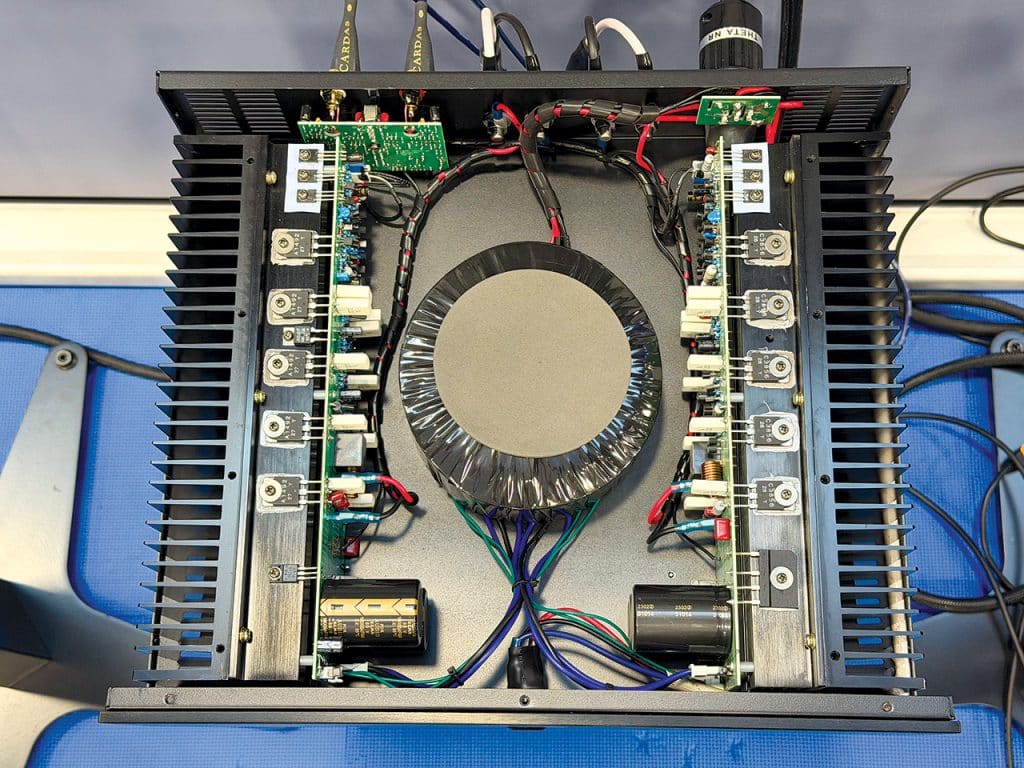
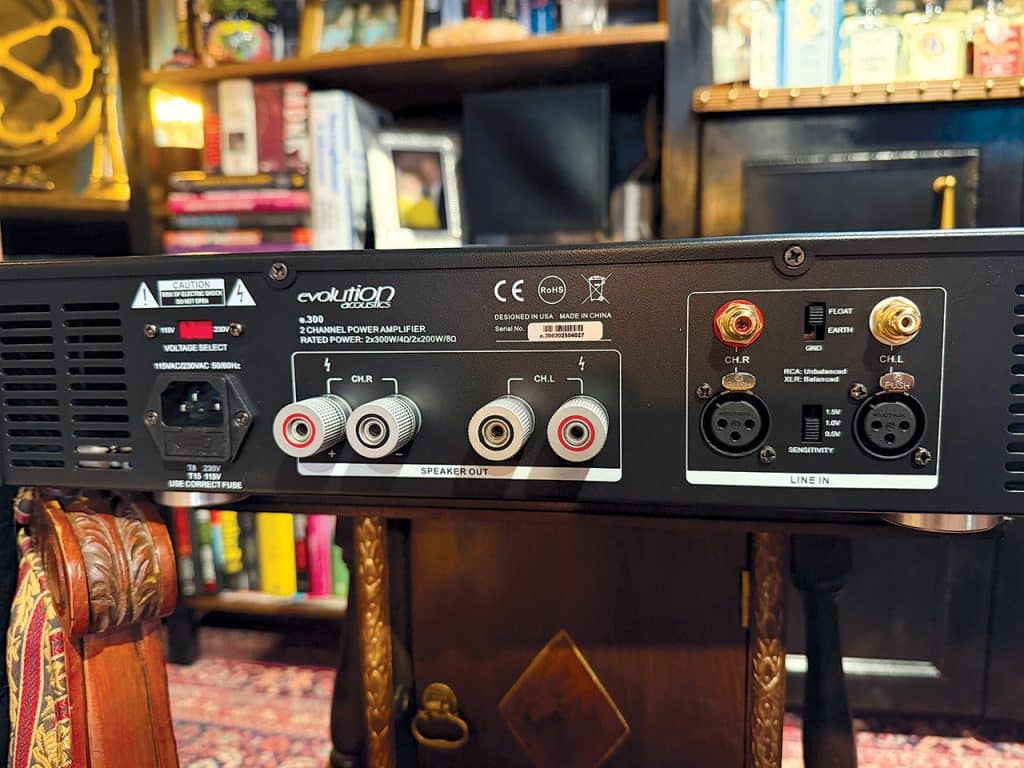
Power is supplied by a Shunyata Research THETA NR 1.75 m cable, a substantial high-end design typically associated with top-tier audiophile systems, complete with its own carrying bag.
Finally, the package includes a set of eight stick-on feet, in case you don’t have isolation, and are putting the cabinets on a desk.
The v.1 Monitors
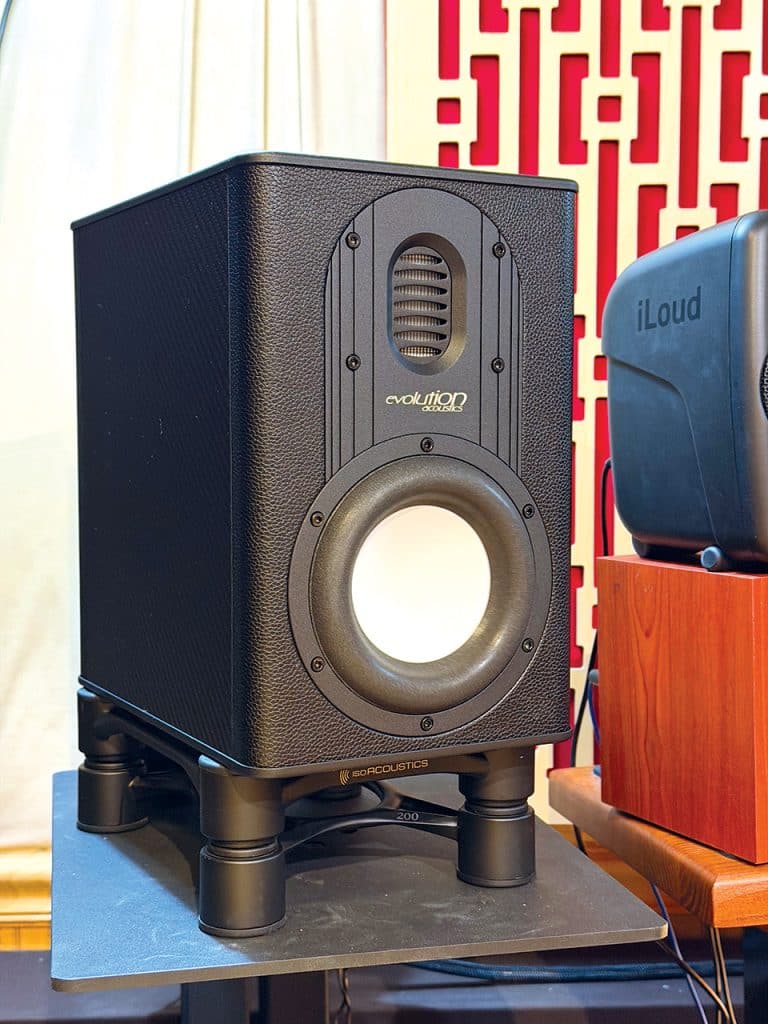
Each Evolution v.1 cabinet measures 11.5″ (H) x 7.5″ (W) x 11.5″ (D). Sizewise, this puts them in what we consider the 5″ and 6″ style monitor category, though their sound and output far exceed what their size suggests.
The cabinets are constructed from multiple layers of high-density proprietary layered fiber coupled to carbon-fiber panels. The front and rear panels are wrapped in black Tolex and capped with aircraft-grade aluminum plates, all designed in San Diego and assembled in Asia.
Internally, the crossover design features reference-grade film-and-foil capacitors, high-purity copper air-core inductors, copper-nickel wire-wound resistors and foamed-dielectric solid-core copper wiring.
Rear-panel connections are a simple, robust pillar-and-post design that matches the power amplifier.
Frequency Response: 35 Hz–45 kHz (–3dB)
Linearity: 50 Hz–40 kHz (±2dB)
Sensitivity: 85dB SPL
Impedance: 4 ohms
Max SPL: 98dB
Crossover Frequency: 1.7 kHz
Drivers and Ports
The tweeter in the Evolution v.1 monitor is a 2″ soft-pleat AMT driver, while the mid/woofer is a 5.5″ long-throw ceramic matrix design. Unlike aluminum, coated paper or resin cones, this driver uses a rigid, bowl-shaped ceramic material that remains extremely thin and lightweight. Every one of these elements is designed in-house by Kevin.
The bass driver features internal staggered pleating and offers an impressive 0.95″ peak-to-peak excursion, allowing it to move a significant amount of air. The design also incorporates multiple self-cooling mechanisms.
At NAMM 2026, Brian showed the driver in free air and explained the progressive spider pleats. These change stiffness as the cone moves farther from center, keeping the performance both fast for midrange detail yet also compliant during large low-frequency excursions, reducing intermodulation distortion.
The completed cabinets, amp and speaker cables are burned in 1,000 hours at the factory to assure full spec performance.
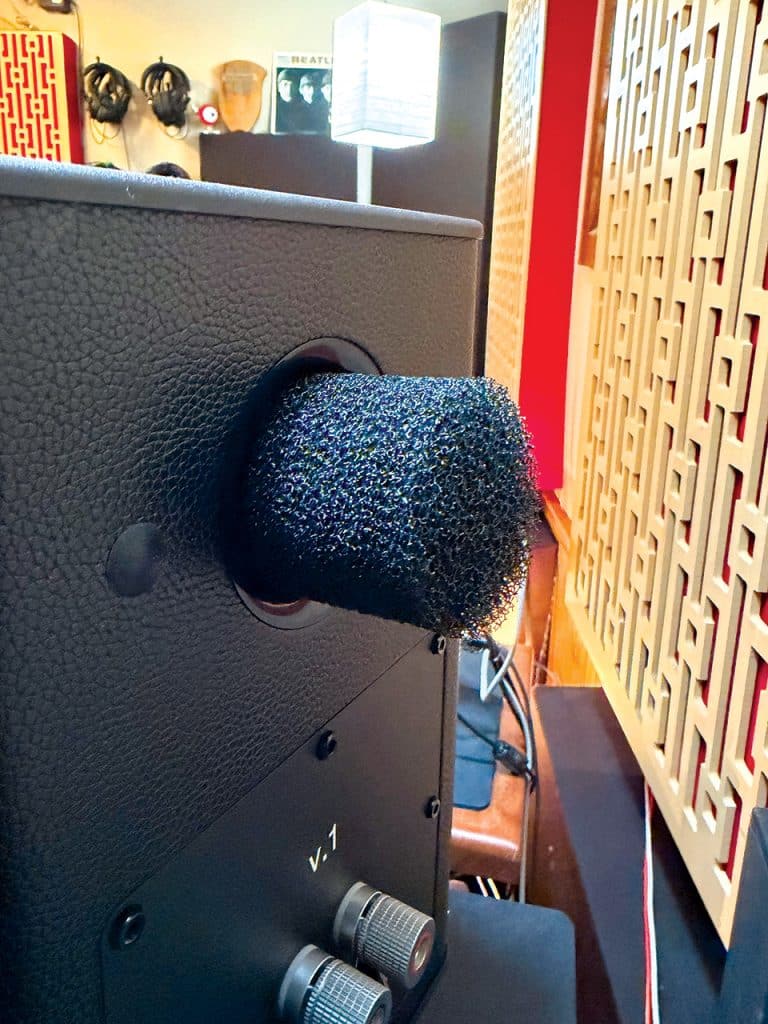
On the rear panel is a bass-reflex port that can be tuned using an insertable foam plug. Varying increments of insertion reduce low-frequency output in tiny or untreated rooms where sub-bass buildup is an issue—a simple but highly effective solution, if needed.
Initial Setup in My “Garden”
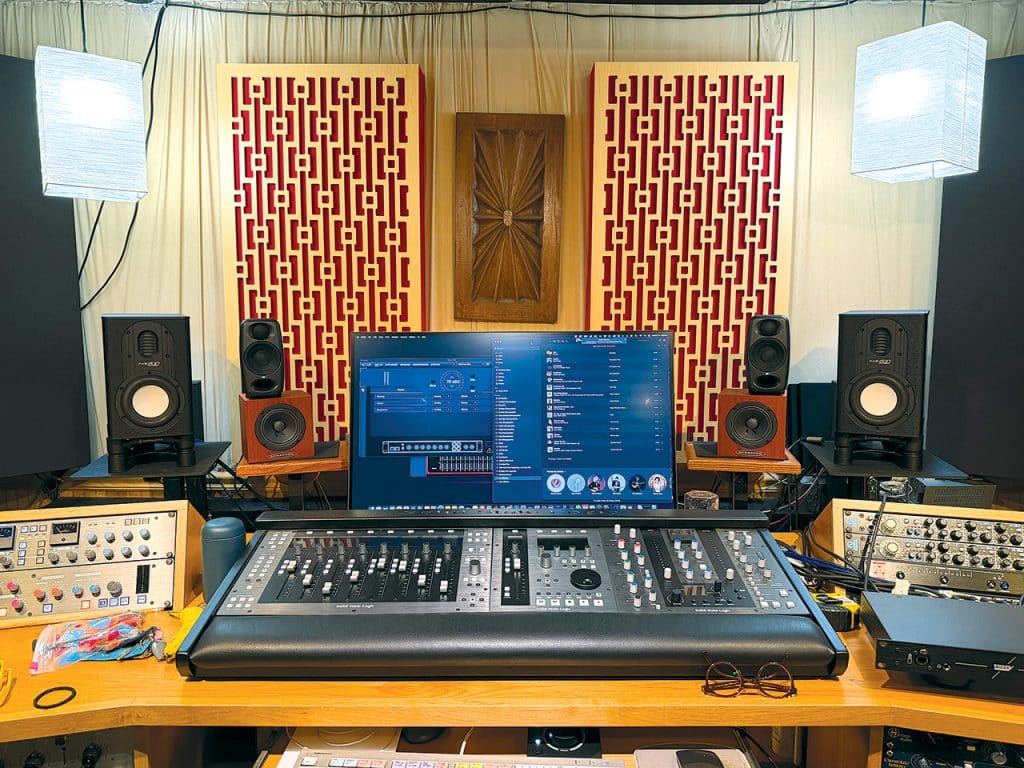
When I first set up the v.1 package in my fully treated mix room at Moss Garden Music, I made several early mistakes. Confident in my experience, I ignored the direction of the speaker cables, did not swap the Acme fuse, and used the standard power and XLR cables already in my system.
Fortunately, I was texting with Gil Griffith from Wave Distribution, who kept asking, “Did you use the THETA NR power cable? Did you swap the fuse? Are the speaker cables in the right direction?”
This underscored that nothing in the Magic Garden Pro Evolution v.1 package—from fuse to cables—was chosen by chance. Every component is intended to be used as supplied for the best mixing results.
I tested the directional speaker cables by listening to “Just You, Just Me” from Nat King Cole’s mono 1957 After Midnight album, running the cables in both directions to each speaker. Placebo or not, the monitor wired as prescribed sounded slightly more dimensional.
Finally, Brian stressed the importance of positioning the tweeters precisely at ear height and allowing 10-30 minutes of warm-up time with a supplied 10 Hz file before serious mixing begins.
Sound & Performance
Sonically, the first thing you notice about the Evolution v.1 is its massive and authoritative low-end extension. I can’t imagine any reason to add a subwoofer—an impressive result from 5.5″ drivers that rival and often exceed the output of many 8″ two-way and some three-way monitors. This is not hyped or boomy bass, but deeply extended, powerful and well defined.
At the opposite end of the spectrum, the high frequencies are clear and detailed yet smooth, with none of the typical “studio monitor brightness” or harsh peakiness.
The most challenging aspect to describe is the midrange. Rather than simply calling it neutral, it is more accurate to describe it as evenly distributed with a firm sense of richness. There is no mid-high presence boost, no low-mid emphasis and no obvious scooping.
Brian explained that one of the voicing goals was to combine the revealing midrange character of classic mid-focused monitors such as NS10 or small cube designs with the full-range power of soffit-mounted mains. This underscores that these are not sweet or flattering monitors, but tools designed to expose flaws in tonal balance and arrangement, while maintaining fullness even at lower listening levels.
The monitors also exhibit excellent phase coherence across a generous sweet spot.
In terms of output, they offer impressive level capability. While well balanced at typical listening levels between 72dB and 82dB, it is easy to push them beyond 92dB without realizing just how loud you are monitoring.
In the Mix
Despite the immediate wow factor of the Evolution v.1 low end, it took some time to adjust to them as a mixing tool—but every monitor has an adjustment period. Everything is presented as very forward and “right there.” While they sound excellent, they do not flatter a source and will make you work—especially when shaping the low and upper midrange. Initially, the snare drum range required the most adjustment for me.
After several solo mixing sessions, I brought in my music and mixing partner to help finalize two mixes. Both translated well outside the studio. One made the album as is, while the other needed a second revision to add a touch more low end to the drum bus. I had initially undermixed the bass because I was hesitant to trust that the powerful low-frequency presentation was accurate rather than hyped.
The second song, mixed by simply trusting what I was hearing, confirmed the accuracy of the Evolution v.1 low end. I revisited the first mix, and Final Mix Rev. 2 became the keeper. With time remaining, we pulled up a third mix that came together surprisingly quickly and also made the album without further revision.
In a Smaller Space
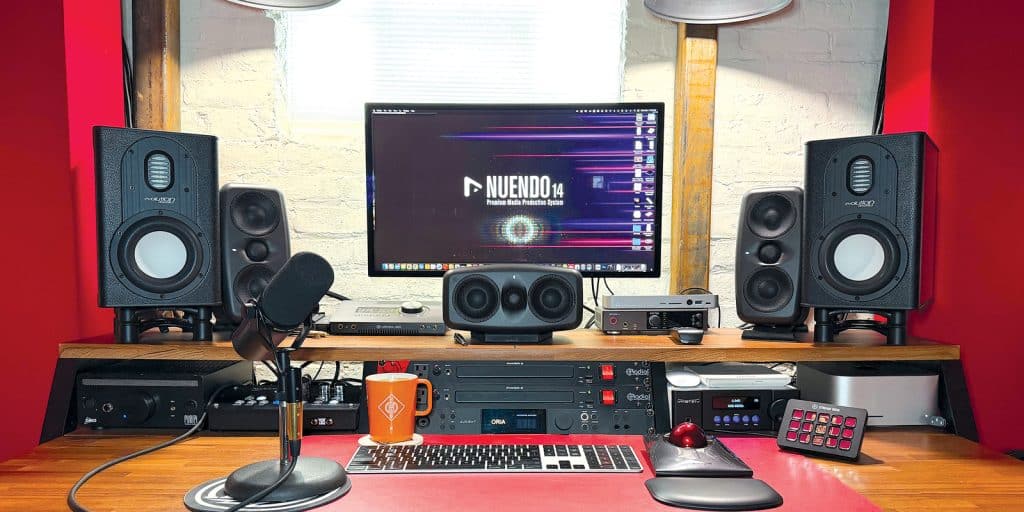
While speaking with Brian Lucey at the NAMM Show, he described successful mixing tests using the Evolution v.1 monitors up close in an untreated closet.
With that in mind, I set the system up in my smaller—though treated—home office (see opening image), which also serves as an editing and listening space. I used the monitors for some general listening and in-the-box premixing for the remainder of the album. Running them in a nearfield 3.5’ listening triangle at approximately 64dB to 70dB SPL, I found that I may actually prefer them in this environment to my larger mix room.
While I still preferred the bass performance with full extension, inserting the port plugs by 1/2” helped better seat the sound in the room and produced a tighter, more controlled low end—a nice option to have.
This confirmed that the Magic Garden Pro Evolution v.1 is a strong solution for engineers who need to do serious work in smaller home studios without compromise. Mix preparation done at home also translated seamlessly when I returned to my main mix room.
Wrap Up
Bottom line, I am thoroughly impressed with the Magic Garden Pro Evolution v.1 monitoring system, and both Brian Lucey and Kevin Malmgren have done an exceptional job with the design and voicing of this package. That said, at $10,000, this is not an inexpensive or entry-level proposition.
This may sound like a backhanded compliment, but it is not so much that I am pleased by the “sound” of the Magic Garden Pro Evolution v.1—it is how pleased I am with the mixes I have completed on them. And when it comes to studio monitors, that is where the real magic lies.
Price: $10,000
More From: magicgardenpro.com