


Past and present unite in a new flagship interface
Review by Paul Vnuk Jr.
The ISA C8X is the latest USB-C multi-channel audio interface from Focusrite. Most notably, it is the first audio interface in the company’s 41-year history to include genuine ISA 110 microphone preamps—not emulations, but the real thing, and you get two of them.
Past Featured Reviews
- Focusrite ISA C8X
- July 2026: JZ Microphones MU-1
- Fender Quantum LT 16 USB-C Audio Interface
- LANDR: An all-in-one music ecosystem
- June 2026: Strymon NightSky Experimental Reverb Plugin
- May 2026: Sennheiser HD 480 PRO
- Neumann Rime
- April 2026: IK Multimedia TONEX Plug
- March 2026: Magic Garden Pro Evolution v.1 Studio Monitor Package
Yesterday and Today
There are two sides of the Focusrite coin. On one side is the legendary recording console heritage, with the mythical Forte console and the legendary Rupert Neve-designed ISA 110 microphone preamp. On the other is the interface company, with products ranging from the ubiquitous Scarlett series to the flagship Red and RedNet ranges.
Simply put, the new ISA C8X brings those two worlds together for the first time, and does so in style.
Big, Bold and Blue
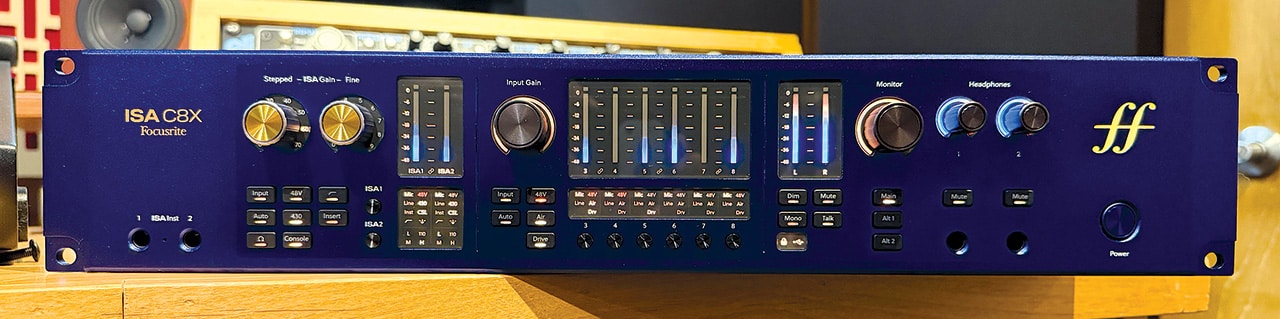
The 2U, 19″ ISA C8X is dressed in a textured aluminum take on the classic ISA blue color scheme. The front panel features a thoughtfully laid-out collection of controls and metering, with dedicated one-to-one buttons for nearly every major function and very little menu diving required for most day-to-day recording and monitoring tasks.
My favorite design touch is the golden-hued, backlit Focusrite Forte logo glowing from the right side of the front panel, offering a subtle nod to the company’s heritage.
Connected
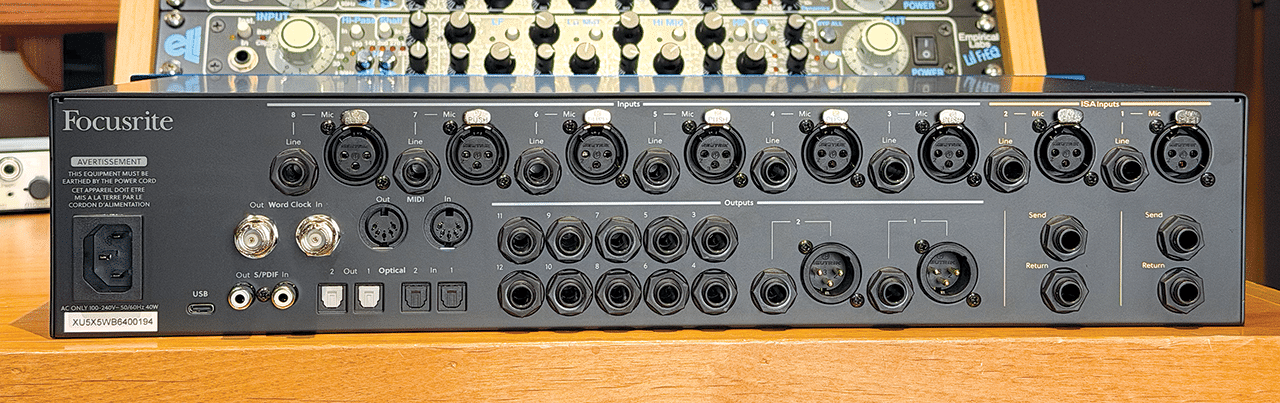
The ISA C8X is a 26-in, 28-out USB-C audio interface. It offers eight analog inputs, each switchable between microphone and line level, along with dedicated instrument inputs on the ISA-equipped channels one and two. Digital connectivity adds another 18 inputs via dual ADAT ports plus stereo S/PDIF.
On the output side are 12 analog outputs (plus two independent headphone outputs), along with 16 channels of ADAT and stereo S/PDIF digital output.
Each analog input offers a choice of balanced XLR or 1/4” TRS connections on the rear panel, while the 1/4” TS instrument inputs are discreetly molded into the front panel. The two ISA channels also feature switchable insert points on dedicated 1/4” TRS send and return jacks—no Y-cables required.
Outputs one and two, intended as the main monitor outputs, provide both XLR and 1/4” TRS connections. The remaining 10 outputs are 1/4” TRS only, although 2 additional stereo pairs can serve as alternate monitor outputs, or all 12 outputs can feed a 7.1.4 Dolby Atmos monitoring system.
Rounding out the connectivity are 5-pin DIN MIDI I/O, dual ADAT optical I/O, phono S/PDIF I/O, BNC Word Clock I/O, USB-C and an IEC mains connector.
Focusrite Greatest Hits
The ISA C8X is very much a Focusrite greatest hits collection. It combines two genuine ISA 110 microphone preamps with six ultra-clean preamps derived from the RedNet range. It also employs the same boutique quality 24-bit/192 kHz converters found throughout the RedNet range.
The ISA C8X also functions as a full-featured monitor controller, which we’ll explore in a moment.
The ISA Preamps
All eight preamps are digitally controlled. While each preamp section shares a common set of controls, each channel gets its own dedicated, smooth, bright, responsive multi-stage input meter (0 to -48dB).
Starting with the ISA preamp section. These are genuine ISA 110 microphone preamps, just like those found in standalone offerings ranging from the single-channel ISA One to the eight-channel ISA 828 MkII. Most importantly, they include the famed Lundahl LL1538 input transformers personally selected by Rupert Neve for the original ISA 110 in 1985. Each ISA preamp provides up to 79dB of gain, a 20 Hz–20 kHz (±0.4dB) frequency response, 117dB(A) dynamic range, -93dB THD+N and an EIN of -128dB(A).
Control is handled by digitally controlled stepped Gain and Fine Gain switches that, despite their electronic implementation, have a decidedly boutique “clicky” analog feel. Dedicated ISA 1 and ISA 2 buttons select which preamp is being adjusted. Beneath the level meters, each channel has its own LED status panel with eight backlit buttons used to engage the available functions.
These include 48V phantom power, a 75 Hz, 18dB/octave high-pass filter, Mic/Line/Instrument selection and switchable insert points. Interestingly, the ISA C8X omits a phase/polarity reverse switch.
The remaining controls are unique to the ISA architecture. Four selectable input impedances (800Ω Low, 1400Ω ISA 110, 2400Ω Med and 7000Ω High) allow you to optimize—or creatively alter—a microphone’s tonal response.
The first ISA C8X-exclusive function is labeled 430, engaging the classic high-frequency enhancing Air circuit first introduced on the now discontinued ISA 430 channel strip. Unlike some other Focusrite interface “Air” offerings, this is a fully inductor-based analog circuit rather than a digital emulation.
The other ISA C8X only feature is Console, another fully analog soft-clip process that introduces the subtle nonlinearities, harmonic character and cumulative coloration associated with signals passing through multiple stages and buses of an analog console.
The final feature—available on all eight preamps—is Auto Gain. Press the button, perform at your normal level and the ISA C8X automatically sets a healthy, conservative recording level. I found it consistently accurate. It is worth noting, however, that the ISA C8X does not include the Clip Safe feature found on the fourth-generation Scarlett range.
One final detail: all of the ISA features described above, including the transformer circuitry, remain available when channels one and two are used in Line or Instrument mode. That makes it possible to run individual tracks, submixes, full stereo mixes or direct instruments through the Console and Air circuits.
I’ve spent a good deal of time obsessing over the ISA preamps and for good reason. This is the first Focusrite audio interface to incorporate genuine ISA preamps (not counting the optional digital cards available for the ISA One, ISA 428 MkII and ISA 828 MkII) and it represents the world’s first digitally (and remote) controlled implementation of the classic ISA 110 microphone preamp.
The Non-ISA Preamps
The remaining six preamps share much of their design with the higher-end RedNet and Red ranges. While they lack the classic transformer-based character of their ISA cousins, they are equally appealing in their own clean, transparent and uncolored way.
Each is controlled via six dedicated channel-select buttons and a single smooth input encoder, surrounded by a halo-style LED that indicates the current gain setting.
Each preamp provides up to 69dB of gain with a 20 Hz–20 kHz (±0.1 dB) frequency response, 116dB(A) dynamic range, -100dB THD+N, a fixed 3200Ω input impedance and an EIN of -127dB(A).
The feature set includes Mic/Line input selection, 48V phantom power and Auto Gain, along with Air, which engages an analog high-shelf circuit similar to the latest Clarett+ range, designed to impart a bit of ISA “flavor.” Also included is a DSP-based variable Drive control that simulates the sound of pushing a classic analog preamp into saturation. When Drive is engaged, the input gain encoder automatically becomes the Drive control, making it easy to dial in just the desired amount of harmonic coloration.
Control Central
The right side of the ISA C8X front panel is dedicated to monitoring and output control. The section begins with a stereo output meter. Beside it is a large, halo-equipped Monitor/Output level encoder.
Below is a surprisingly comprehensive monitor control section featuring Dim, Mono, Mute and Talkback controls. Note that the Talkback mic is the tiny pinhole located between the two 1/4” instrument inputs. It sounds quite good for its size.
Lastly, there is a choice of Main, Alt 1 and Alt 2 buttons for switching between as many as three sets of monitor speakers.
The ISA C8X can also serve as a 12-channel Dolby Atmos monitor controller. Unlike some competing solutions, however, there is currently no provision for storing speaker-specific delay, level or EQ calibration within the hardware itself. Fortunately, a number of third-party room correction and speaker management applications are well suited to the task.
The section is completed by two independently assignable, halo-equipped headphone level controls, each paired with its own 1/4” TRS output. Rounding out the front panel is a classy blue anodized power button.
Focusrite Control 2
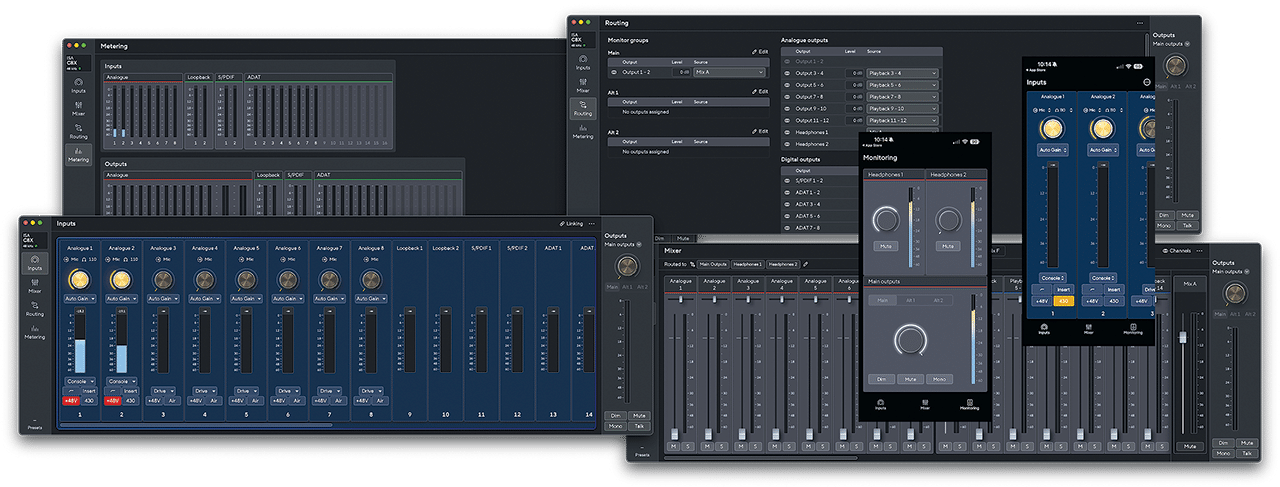
While most day-to-day functions are accessible directly from the front panel, a handful of deeper settings reside within the Focusrite Control 2 software. These include sample rate and clock settings, monitor configuration and grouping, advanced routing—including Talkback—as well as the ability to create, store and recall up to eight custom monitor mixes for tracking or playback. Those mixes can be assigned to any output pair, the headphone outputs or the main monitor outputs.
More importantly, Focusrite Control 2 provides complete remote control of the ISA C8X from your computer or, even more impressively, from anywhere in the studio using an iOS or Android phone or tablet. I tested the app on my iPhone and was genuinely impressed by both its scope and ease of use, even on a smaller screen. Setup was equally painless thanks to a simple QR code pairing process.
The only feature I found myself missing—both here and in the RedNet Control software—is the ability to click on a parameter and enter a numeric value. Dragging sliders works well enough, but direct numerical entry would make precise level matching much faster.
While we’re on the subject of quibbles, I initially lamented the lack of Dante or DigiLink expansion. After giving it some thought, however, I realized those protocols serve a much smaller segment of users, would almost certainly increase the cost of the ISA C8X and are already well covered by the Red and RedNet ranges.
In Use
I installed Focusrite Control 2 and had the ISA C8X up and running in my studio in less than five minutes, not counting the physical wiring—and even that was as straightforward as it gets.
I had no trouble configuring my main monitors and two sets of secondary speakers, while Focusrite Control 2 made creating custom headphone mixes quick and intuitive. Most importantly, the ISA C8X simply sounded fantastic from the moment I powered it on.
My studio centers around a Focusrite Red 16Line paired over Dante with an ISA 828 MkII and I heard no meaningful difference in conversion quality between the Red 16Line and the ISA C8X. Likewise, the ISA preamps in the ISA C8X sounded every bit as good as those in the ISA 828 MkII.
In fact, I found myself a little jealous of the 430 and especially the Console features, neither of which are available on my ISA 828 MkII. Both processes are intentionally subtle, yet the cumulative effect becomes increasingly noticeable as tracks stack together in a mix. I was particularly impressed by what the Console circuit did to direct bass guitar.
I am also quite pleased that Focusrite included the impedance switching options found on the standalone ISA units. While the ISA 110 setting remains my favorite, the other three settings offer a variety of creative tonal options. In general, the 800Ω setting sounds fuller, richer and slightly softer on transients, while the 7000Ω setting tightens the low end and accentuates a microphone’s top-end presence. Of course, the results vary from microphone to microphone, particularly with passive ribbons, dynamic microphones and many self-powered tube models.
Also worth noting is that the instrument input offers a choice of Low (470 kΩ) or High (2.4 MΩ) impedance settings.
Wrap Up
I truly believe that the ISA C8X might just be the best-designed, best-thought-out and most elegantly implemented audio interface Focusrite has produced to date. It combines two genuine ISA 110 preamps with six outstanding transparent preamps, flagship RedNet conversion, comprehensive monitor control—including Dolby Atmos support—and an exceptionally refined user experience. That’s an impressive amount of capability in a single 2U interface.
If you’re looking for a premium eight-channel interface that blends Focusrite heritage with modern workflow, the Focusrite ISA C8X deserves a place at the top of your audition list.
Price: $2,299 (includes the Hitmaker Expansion curated plugin bundle with Sonnox upgrade options available)
More From: focusrite.com