

Deep, shifting, textural reverb awaits
Review By Paul Vnuk Jr.
Following on the heels of the Cloudburst Ambient Reverb plugin reviewed in September 2025, the Strymon NightSky Experimental Reverb is the sixth of the company’s DSP-based effects pedals to make its way into plugin form. Let’s embrace the night and see how it fares.
Past Featured Reviews
- October 2026: Chandler Limited REDD Mixing System
- September 2026: Barefoot Sound Footprint 01 Gen 02 and Footprint 02 Gen 02
- iamReverb
- August 2026: Focusrite ISA C8X
- July 2026: JZ Microphones MU-1
- Fender Quantum LT 16 USB-C Audio Interface
- LANDR: An all-in-one music ecosystem
- June 2026: Strymon NightSky Experimental Reverb Plugin
- May 2026: Sennheiser HD 480 PRO
From Pedal…
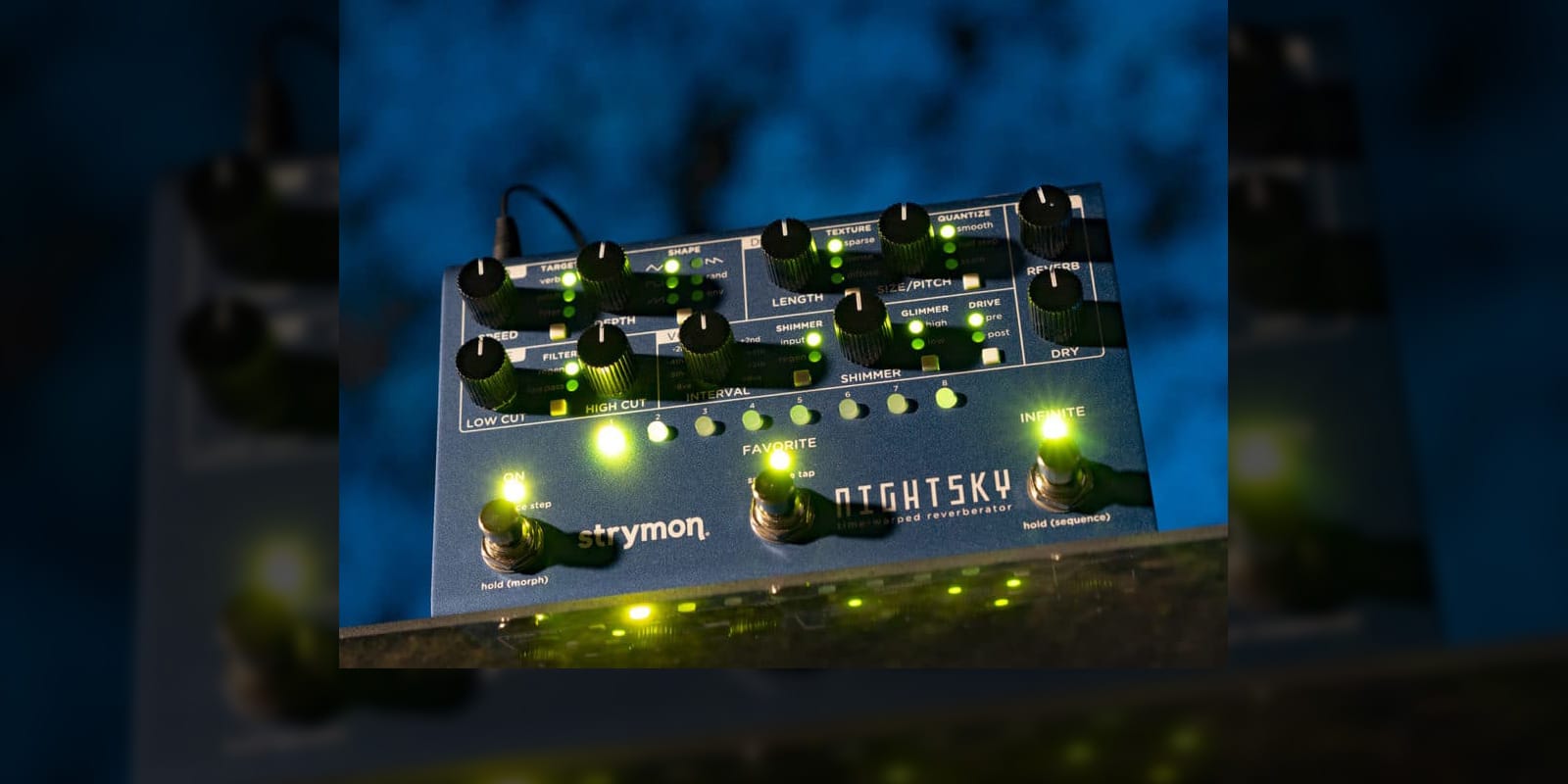
It’s hard to believe it has been more than five years since I reviewed the Strymon NightSky pedal in our January 2020 issue, where I called it “…a positively twisted new reverb pedal” capable of “deep space transmissions decaying from distant satellites.”
With multiple dedicated reverbs already in the lineup—including Cloudburst, BigSky, BigSky MX and BlueSky V2—along with reverb-equipped designs like Flint and El Capistan V2, what sets NightSky apart? As I noted then, its reverb stream is shaped by pitch, filter and modulation engines, alongside an internal eight-step sequencer.
As expected, nearly all of that functionality carries over to the plugin. The one omission is the sequencer, and whether that matters depends on your workflow.
…To Plugin
Where most stompbox effects keep things simple, the NightSky pedal leans closer to a compact synthesizer, with an expansive control set that can take time to master.
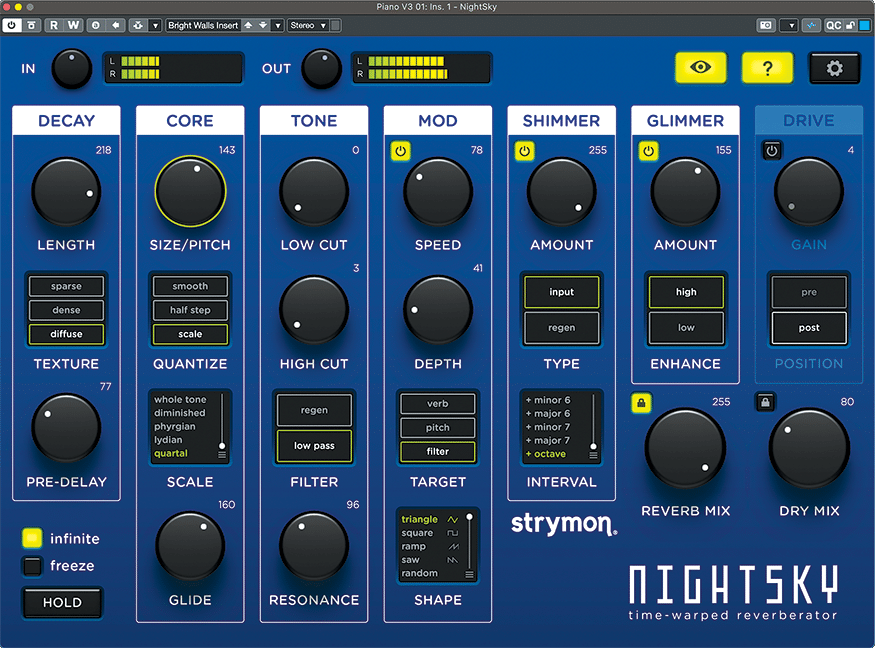
Here, the plugin has a clear advantage. It makes no attempt to mimic a physical pedal, instead presenting all parameters in a clean, expanded layout. The original five sections are reorganized into seven more intuitive ones, and previously hidden secondary functions are now immediately accessible, making navigation faster and far more approachable.
Charting the Constellation
The NightSky plugin begins with master input and output sections, complete with knobs and stereo LED meters. There is also an “eyeball” button that toggles each section’s numeric values, a “?” button that calls up handy pop-up explanations for every control, and a gear button that opens a simple settings menu where you can check the plugin version, adjust the GUI size and select how numeric data is displayed. Note that preset management is handled by your DAW.
On the lower right—just like the hardware—you will find individual Reverb and Dry signal mix knobs, each with a locking feature. Finally, before we dive into the dedicated sections and parameters, you will find a master Hold button (previously a dedicated stomp switch) offering classic Infinite and Freeze reverb functions.
Seven Sections
Moving left to right, we begin with the Decay section. This forms the foundation of the reverb, offering control over reverb length, pre-delay and a choice of sparse, dense or diffuse reverb types.
Next is Core. Here you will find a Size/Pitch control that does exactly what it suggests—changing the perceived size of the reverb space while simultaneously altering pitch in a manner reminiscent of slowed or sped-up tape. From there, you can determine how pitch changes behave: smooth, in half-steps or quantized to a selectable scale, with 11 scale options available. A final—formerly hidden—Glide control sets how quickly the pitch shifts or morphs as the Size/Pitch parameter is adjusted in real time, modulated or automated in your DAW.
The Tone section provides low-cut and high-cut shelving filters. The high filter can be set to Regen, which progressively removes high frequencies from the reverb core, or switched to a synth-style resonant low-pass filter with adjustable resonance.
The Mod section is where things take on a more synth-like character. Here, you can choose from five classic LFO shapes—triangle, square, ramp, saw or random—with full speed and depth controls to modulate the reverb, pitch or filter sections. This section also allows you to switch from LFO modulation to a classic triggered attack/decay envelope, complete with a sidechain option if supported by your DAW.
Shimmer introduces a classic “crystal”-style pitch-shifting effect, with selectable intervals up to an octave above or below the source. It can be applied at the input stage or set to Regen, where it continuously feeds back into the reverb core as the tail decays.
Glimmer adds a dynamic harmonic enhancement to either the high- or low-frequency content of the input signal, while the final Drive section introduces soft clipping, which can be applied either pre- or post-reverb.
Note that Decay, Core and Tone are always on, while the other sections can be individually bypassed.
Flying Through the Night
The NightSky is capable of covering a surprising amount of ground. At its most straightforward, it delivers convincing room- and hall-style reverbs, along with the kind of modulated tails that defined many algorithmic units of the ’80s and ’90s. It also handles the familiar “crystal-style” pitched reverb, but with its own distinct, more restrained character that sets it apart from the more overt Strymon Cloudburst. Here, the effect can feel either more immediate and upfront at the input stage, or more deeply and murkily interwoven into the reverb stream when set to Regen.
Thanks to its modulation options, envelope shaping and the addition of Glimmer, Drive and sidechain capabilities, the NightSky can easily shift into more modern effects territory—pulsing, breathing and even crunchy, grungy electro-style sound design textures that feel alive, organic and reactive to the source material.
To my ears, the overall character leans more toward room and hall spaces rather than a plate-style sheen. What stands out most is how quickly you can dial in subtle or exaggerated movement to otherwise “normal” space. Small adjustments can introduce evolving harmonic shifts, gentle pitch drift or dynamic filtering that keeps things from ever feeling static.
Plugin Versus Pedal
Similar to my past experiences with Strymon pedals translated into plugins, the overall sound and effects here are essentially identical, with any perceived sonic differences coming down to gain staging and signal flow.
While the hardware’s eight-step sequencer is not present, the plugin arguably gains flexibility in return. Parameter automation and modulation within modern DAWs—such as dedicated modulators in Cubase or Ableton Live—can easily take its place, often with deeper control. In practice, this becomes a trade-off between the hardware’s immediate, hands-on simplicity and the plugin’s more expansive, customizable approach.
Conclusion
As much as I love the NightSky pedal—which is constantly present somewhere in my live analog synth rig—I would argue that the plugin version of the Strymon NightSky simply makes more sense in overall use. It is more logically laid out, and the automation and modulation capabilities of a DAW open the door to deeper sound design possibilities. Importantly, the plugin retains the same unique sonic character that made the original stompbox so compelling.
Price: $99
More From: strymon.net