


Multi-instrument setup? Need inputs? No sweat.
Review by Bill Stunt
Fender has recently released a new range of audio interfaces built squarely on its former PreSonus roots. The Quantum LT series features low-latency custom drivers, brand-new MAX-HD preamplifiers and Fender-designed instrument inputs. The series was designed with content creators in mind who are looking for solid build quality, a modern and intuitive design, and flexible analog I/O.
Past Featured Reviews
- Fender Studio Quantum LT 16 USB-C Audio Interface
- LANDR: An all-in-one music ecosystem
- June 2026: Strymon NightSky Experimental Reverb Plugin
- May 2026: Sennheiser HD 480 PRO
- Neumann Rime
- April 2026: IK Multimedia TONEX Plug
- March 2026: Magic Garden Pro Evolution v.1 Studio Monitor Package
- Kali Audio HP-1
- February 2026: AKG C104, C114 & C151
Quantum Energy
The range includes the 2-channel Quantum LT 2, the 4-channel Quantum LT 4 and the 16-channel Quantum LT 16. Although the channel counts and I/O configurations differ, the underlying technology and component specifications remain the same. I’ll focus on the LT 16 for this review, but many of my observations will apply across the entire series.
The Quantum LT interfaces are USB-C devices. They ship with a generous 1.5-meter USB-C to USB-C cable. Unlike the smaller bus-powered models in the series, the Quantum LT 16 includes an external power supply, again with thankfully long cables.
Remote Workflow
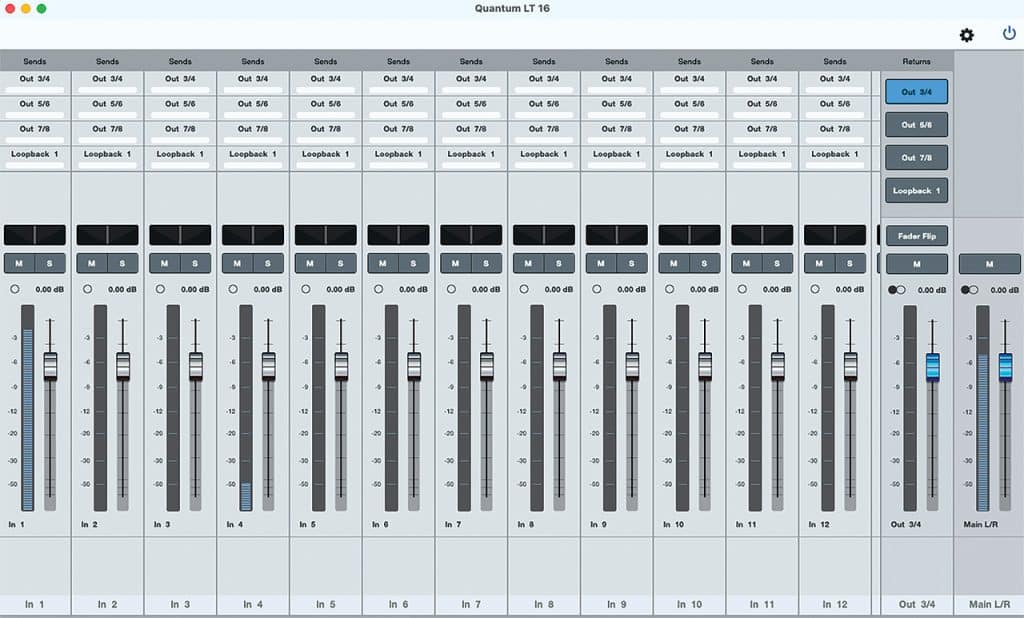
Like former PreSonus interface designs, the LT 16 is supported by the Universal Control application, which you can download from the MyFender website after registering the device. The download and installation process takes only a few minutes. In addition to serving as the driver management utility, Universal Control functions as a software control interface, offering device setup management and low-latency monitoring via a dedicated mixer with send, return and loopback buses.
Universal Control can also be operated remotely using an app available for iOS/iPadOS and Android devices connected to the same Wi-Fi network as the host computer. It’s a slick workflow I already know well. The PreSonus StudioLive 32SE console at the heart of my studio offers much of the same functionality.
Ins and Outs—Front and Back
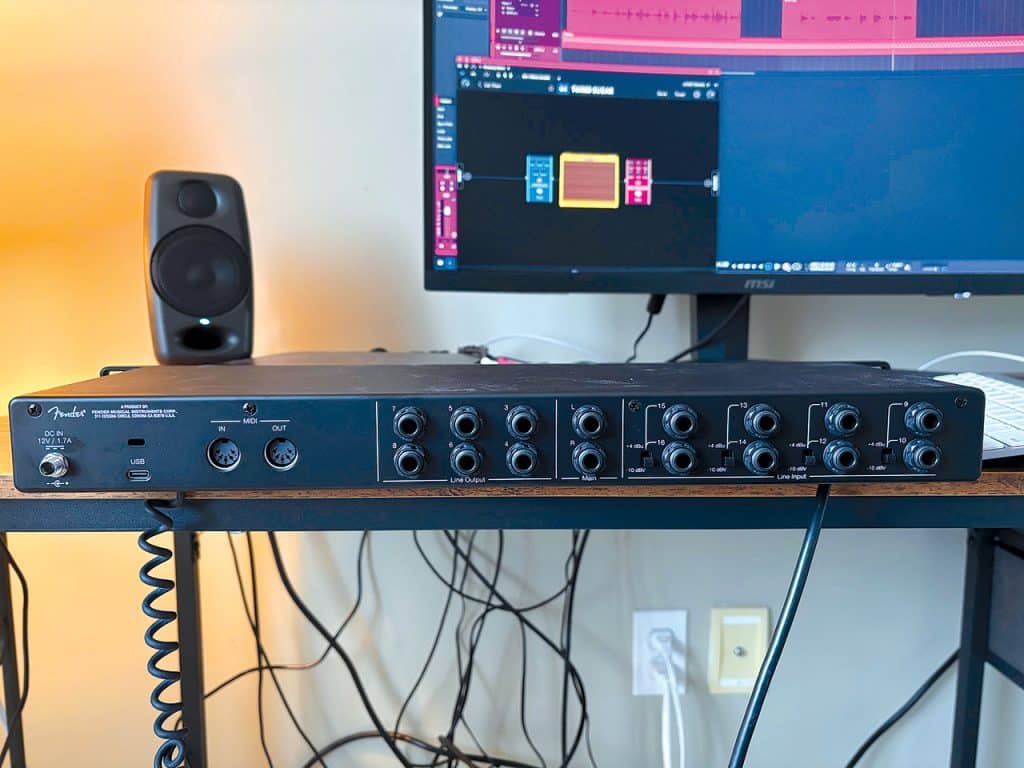
The LT 16 is connectivity-rich. There are eight XLR/TRS inputs on the front panel connected to the MAX-HD preamplifiers. Guitars and basses can be connected directly to the first two inputs via the 1/4” jacks using a circuit specifically designed by Fender for instrument use. The 1/4” ins on the remaining six inputs are standard line-level connections.
There are separate phantom power switches for inputs 1–4 and 5–8. Each input has a dedicated gain knob. Onboard metering is basic, with an LED that glows green when signal is present and red when clipping occurs. Input levels can be monitored more precisely within the Universal Control mixer or the Fender Studio Pro DAW. A license for the latter is included with the package.
A large Main Volume knob controls the output level of the main left/right outputs. A Direct button engages low-latency monitoring, which can also be enabled within Universal Control. A 1/4” headphone jack with its own volume control and power switch rounds out the front-panel features.
The back panel includes eight additional 1/4” balanced line-level inputs, laid out in convenient stereo pairs when needed, that can be switched between +4dBu and -10dBV operation. There are also eight 1/4” balanced outputs, with outputs 1 and 2 designated as the main left/right monitor outputs.
Keyboards and Eurorack? No problem.
The benefits of the Fender ecosystem extend well beyond guitarists. Nicely, the six 1/4” line outputs are DC-coupled, which will be of particular interest to modular synth users. Fender Studio Pro includes a CV Instrument plugin that serves as a software bridge.
MIDI I/O is handled via a welcome pair of 5-pin DIN connectors on the back panel. Increasingly rare these days, traditional 5-pin MIDI connections remain important to many users. The external power supply connection and USB-C port round out the back-panel features.
Specs
The Quantum lineup supports sample rates from 44.1 to 192 kHz at 24-bit resolution. The microphone input gain range is 0 to 75dB with an input impedance of 1600 Ω. THD is rated at 0.001%, dynamic range at 115dB, and EIN at -128.6dBu.
The line inputs and outputs offer the same dynamic range and THD specifications as the microphone inputs. Line-level input impedance is rated at 10 kΩ.
My Ears Say
The LT 16 is refreshingly straightforward in both design and operation. The manual is well organized and filled with helpful graphics, but in truth, figuring out the interface is dead simple.
The MAX-HD preamplifiers are very good—a noticeable step up from earlier PreSonus designs, which is saying something. The XMAX preamplifiers already had a strong reputation for clean, uncolored sound. The new Fender co-design builds on that legacy with greater headroom and even more accuracy. Clean, quiet and uncolored, they sound fantastic.
I paired them with several condenser, ribbon and dynamic microphones with equally impressive results. With up to 75dB of gain and 16 kΩ impedance, my phantom-powered signal boosters stayed in the drawer while auditioning an RCA BK-5 ribbon microphone and a PreSonus PD-70. The MAX-HD preamplifiers are especially well suited for podcasting, where the gain-hungry Shure SM7B remains nearly ubiquitous.
These preamplifiers accurately capture whatever you feed them. They do not impose much character of their own, but they excel at revealing the nuances of the connected microphone, pairing beautifully with models that already have a strong sonic personality.
The abundance and variety of I/O make the LT 16 ideal for recording small to medium-sized groups and for project studio owners who prefer to keep a variety of microphones, guitars, basses and synths connected simultaneously. It’s a great workflow to have your workhorse instruments always patched in so you are never hunting for a cable when inspiration strikes. DC-coupled outputs and selectable line-input voltage—features you do not encounter every day—make the connectivity even more flexible.
Immediately Versatile
Immediacy seems to have been a key design goal behind both the variety and quantity of connectivity. That same philosophy extends to the virtually undetectable latency. Monitoring through plugins and virtual amp simulators is genuinely enjoyable. The Fender Studio Pro DAW includes two amp-modeling suites: Mustang and Rumble. Using the Fender-designed guitar and bass inputs, I noticed improved transient response and a more dynamic interaction with the amp models. It’s amazing how much difference proper impedance matching can make.
If all of that still is not enough, the LT 16 can also function as a standalone mixer or preamplifier when not connected to a computer. In mixer mode, all inputs can be summed to the main outputs. In preamplifier mode, each input is routed directly to its corresponding output. From there, the outputs can feed another audio interface or connect directly to a mixing console.
Wrap Up
The Fender Studio Quantum LT 16 is a modern, thoughtfully designed interface that delivers professional performance, flexible workflow options and outstanding sound at a highly competitive price. Fender has not only preserved what made earlier PreSonus interfaces successful, but meaningfully improved upon the formula.
Price: $499 Quantum LT 16; $169 Quantum LT 4; $129 Quantum LT 2
More From: fender.com