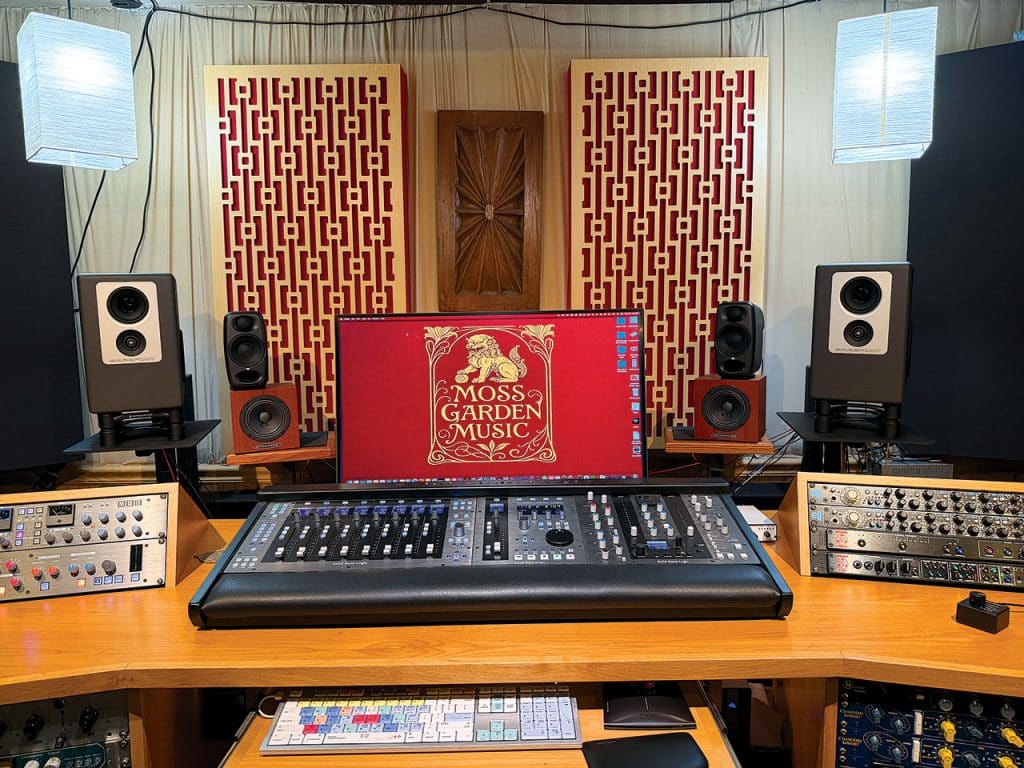

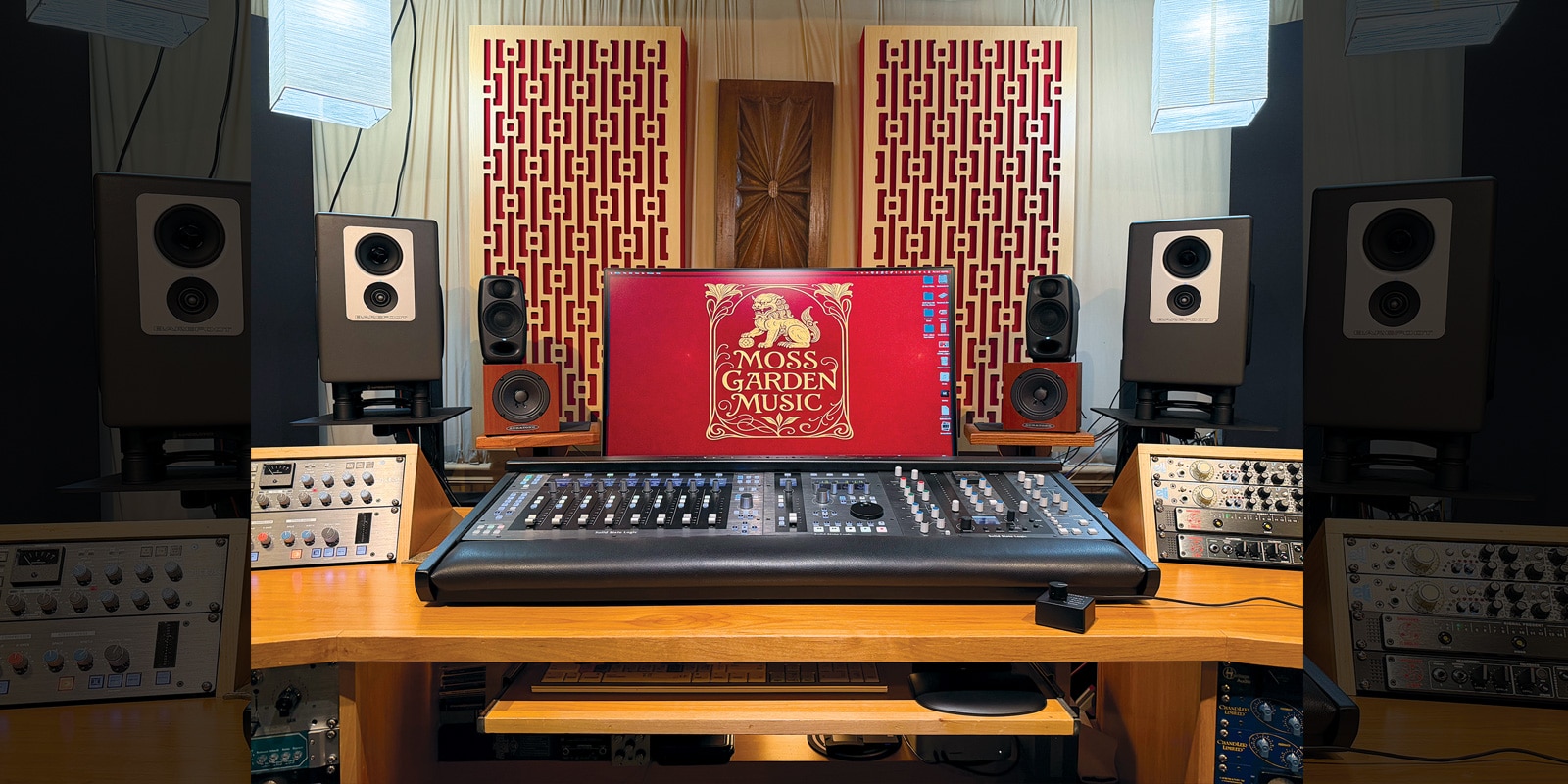
Small size, big sound, redesigned and refined
Review by Paul Vnuk Jr.
The Barefoot Sound Footprint 01 Gen 02 and Footprint 02 Gen 02 loudspeakers represent a significant upgrade over the previous-generation Footprint models, once again offering the signature Barefoot Sound sound in a compact “footprint” at a more approachable price point.
Past Featured Reviews
- October 2026: Chandler Limited REDD Mixing System
- September 2026: Barefoot Sound Footprint 01 Gen 02 and Footprint 02 Gen 02
- iamReverb
- August 2026: Focusrite ISA C8X
- July 2026: JZ Microphones MU-1
- Fender Quantum LT 16 USB-C Audio Interface
- LANDR: An all-in-one music ecosystem
- June 2026: Strymon NightSky Experimental Reverb Plugin
- May 2026: Sennheiser HD 480 PRO
Barefoot Sound
Barefoot Sound was founded in 2006 by Thomas Barefoot and Tedi Sarafian, building on a vision to create studio monitors that could bridge the gap between large-format mains, nearfield monitors, and mastering loudspeakers. What began as a single loudspeaker design, appropriately called the MicroMain, has grown into a company recognized worldwide for its stated goal of taking an uncompromising approach to loudspeaker engineering.
Today, Barefoot Sound is powered by a dedicated team of engineers, designers, and manufacturing specialists based in
Portland, Oregon. I’m told that every product is the result of a collaborative design process, where decades of engineering expertise, precision manufacturing, and relentless refinement come together to create monitoring systems trusted by the world’s leading producers, engineers, and recording studios.
Over time, the company’s catalog has expanded to include multiple MicroMain models along with the MiniMain, MicroStack, MasterStack, subwoofers and more. Most of these offerings live unapologetically in the upper reaches of the professional loudspeaker realm, with prices ranging from roughly $5,000 to $45,000, depending on the model and configuration.
A Smaller, Affordable Barefoot
For that reason, nearly a decade ago, Barefoot Sound introduced the Footprint series to deliver a compact, no-compromise and more affordable Barefoot Sound monitor. Today, the Footprint lineup consists of three models: the Footprint 01, the Footprint 02 and the Footprint 03—the first ported design in the lineup, which Alex Hawley reviewed in our November 2024 issue.
When it was released, the Footprint 03 introduced many of the design advances and technologies now found in the Footprint 01 Gen 02 and Footprint 02 Gen 02, which are far more than simply modest updates. Rather, they have been almost completely redesigned from the ground up.
A Whole New Footprint
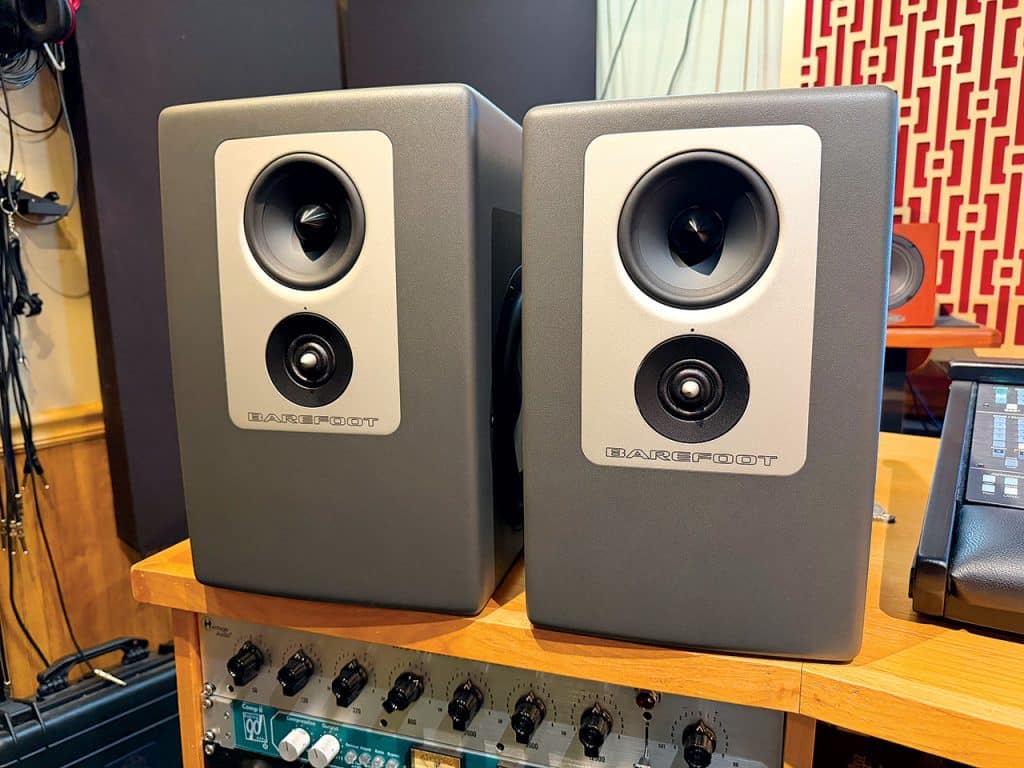
The Footprint 01 Gen 02 and Footprint 02 Gen 02 share the same overall architecture and industrial design. Both are tri-amplified, three-way active monitors built around a machined aluminum front baffle set into a heavily braced, fully sealed MDF enclosure with extensive internal acoustic damping dressed in a rugged, gray, textured polyester finish.
While the original and Gen 02 models look nearly identical, the new versions are slightly larger and the tweeter and woofer cones are different colors due to changes in their design and materials, which we’ll explore momentarily.
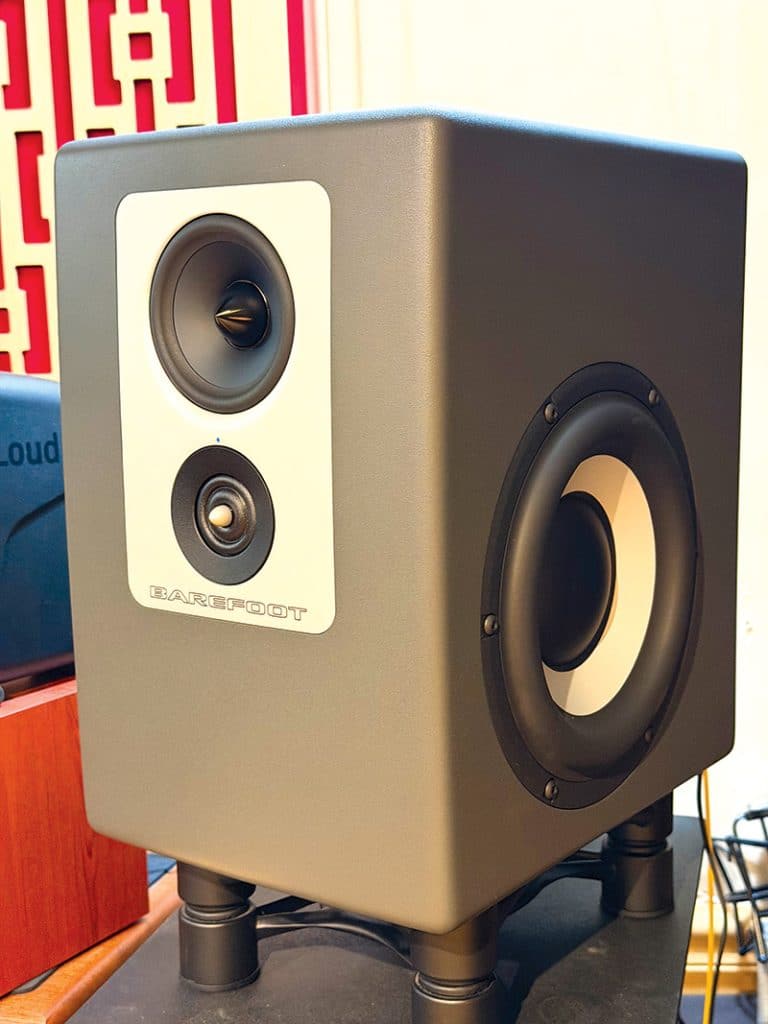
The Footprint 01 Gen 02
Measuring 18.25″ (h) × 10.5″ (w) × 13.75″ (d) and weighing 44 lbs, the Footprint
01 Gen 02 is equipped with dual 8-inch aluminum-cone woofers and 710 watts of total Class D amplification. Published specifications include a frequency response of 36 Hz to 40 kHz, a maximum continuous SPL of 113dB and crossover frequencies of 170 Hz and 3.6 kHz.
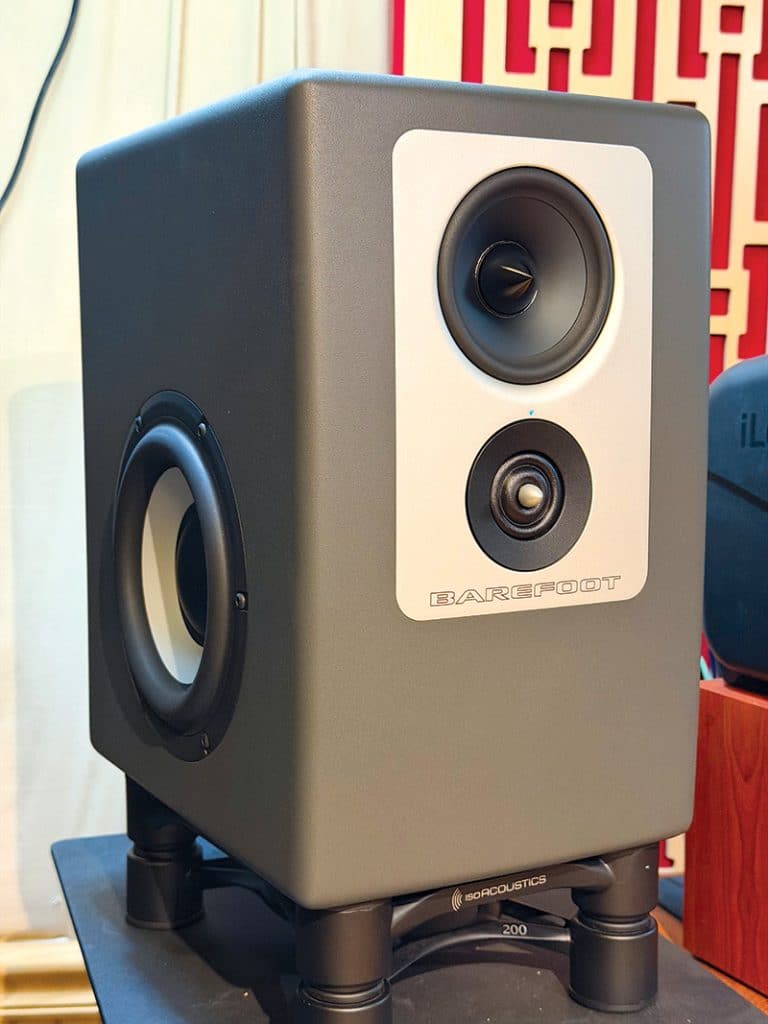
The Footprint 02 Gen 02
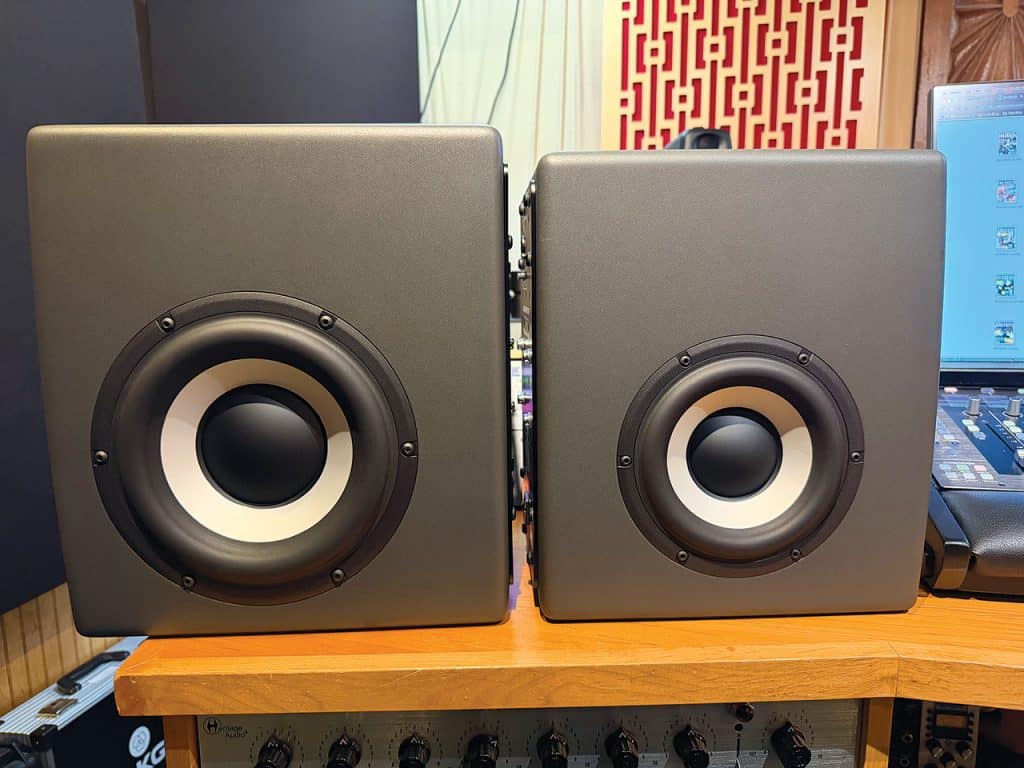
Measuring 15.75″ (h) × 9.25″ (w) × 11.5″ (d) and weighing 34 lbs, the Footprint 02 Gen 02 is only slightly smaller than its larger sibling [See Photo]. It employs dual 6.5-inch aluminum-cone woofers with 410 watts of total Class D amplification, a published frequency response of 38 Hz to 40 kHz, a maximum continuous SPL of 111dB and crossover frequencies of 180 Hz and 3.7 kHz.
 Backside
 Backside
The rear panel of each cabinet includes a stepped input level attenuator (+3 to -9dB), a 1/4” TRS/XLR combo input and a pair of 1/8” in/thru jacks for the SPOC feature. Also included are a USB-C port for factory use only, a 3-prong IEC mains power inlet and robust mounting points for wall installation.
Upside Down World
With the Footprint 01 and Footprint 02 models, you need to unlearn a bit of what you know about speaker layout.
Each cabinet employs a vertically aligned 5-inch midrange driver that, unlike most traditional loudspeakers, sits above the 1-inch tweeter. Even more noticeable when looking at the front baffle is the absence of a woofer. A long-standing hallmark of many Barefoot Sound designs, the Footprint 01 and Footprint 02 models employ opposing side-mounted woofers rather than a single front-firing bass driver. Beyond the acoustic benefits, this configuration also contributes to each cabinet’s relatively compact height.
I should note that despite their shorter stature compared to most traditional 6.5-inch and 8-inch monitor designs, the Footprint 01 Gen 02 and Footprint 02 Gen 02 are among the heaviest monitors I have encountered in this size class.
New Drivers
Across the board, the drivers in the Gen 02 models feature redesigned motor systems that provide greater linear excursion, improved heat dissipation and copper shorting (Faraday) rings to reduce harmonic and intermodulation distortion.
The Low-Down on the Lows
 The Low-Down on the Lows
Starting with the low-frequency drivers, the rigid black paper-cone woofers found in the original models have been replaced with newly designed aluminum-cone drivers featuring high magnetic flux motors. The Footprint 01 Gen 02 employs dual 8-inch woofers, while the Footprint 02 Gen 02 uses dual 6.5-inch versions.
Once again, the opposing woofer arrangement employs what Barefoot Sound calls Dual-Force Technology, where the two woofers are mechanically coupled to cancel cabinet vibrations. According to Barefoot Sound, this design minimizes cabinet resonance and distortion while producing tighter, more controlled low-frequency reproduction.
More Mids
 More Mids
Both the Footprint 01 Gen 02 and Footprint 02 Gen 02 employ the same midrange and high-frequency drivers.
The original models featured a 4″ aluminum-cone midrange driver, while the Gen 02 models step up to a new 5″ aluminum-cone driver with increased sensitivity. Rather than using a conventional low-profile dust cap, the Footprint series midrange employs a torpedo-shaped phase plug. This design reduces air pressure behind the cone, lowers moving mass, improves dispersion and contributes to the improved heat dissipation discussed earlier.
New Heights to the Highs
 New Heights to the Highs
While the Gen 02 tweeter remains a 1″ dual-ring radiator design, it has been completely redesigned. The Footprint 01 Gen 02 and Footprint 02 Gen 02 now employ the same tweeter found in the Footprint 03, featuring a fabric diaphragm housed in aluminum, along with a solid aluminum phase plug.
As before, the tweeter sits below the midrange driver. According to Barefoot Sound, this arrangement better focuses the acoustic energy at ear level.
To help position the monitors at the proper listening height, Barefoot Sound placed the front-panel blue power LED, which turns red if the speaker clips, at ear level.
Power and Crossover
While the previous-generation models were also three-way designs, they were bi-amplified. The Gen 02 models are tri-amplified, with dedicated Class D amplification for each driver.
The Footprint 01 Gen 02 provides 710 watts of total power, divided between a 60-watt tweeter amplifier, a 150-watt midrange amplifier and 500 watts dedicated to the dual woofers. The Footprint 02 Gen 02 provides 410 watts of total power, with 60 watts driving the tweeter, 150 watts the midrange and 200 watts the dual woofers.
The active crossover frequencies are 170 Hz and 3.6 kHz for the Footprint 01 Gen 02 and 180 Hz and 3.7 kHz for the Footprint 02 Gen 02.
SPOC
Arguably, the biggest change in the Footprint 01 Gen 02 and Footprint 02 Gen 02 is the implementation of the patented Barefoot Sound crossover and conversion technology known as SPOC. Alex Hawley first introduced SPOC in his review of the Footprint 03.
SPOC stands for SPectrally Optimized Conversion. Despite its digital-focused name, the system employs an analog crossover stage ahead of the internal 24-bit/96 kHz converters. According to Barefoot Sound, this allows high-frequency information to reach the converters without attenuation, resulting in an effective 5-bit increase in resolution and a 15dB improvement in signal-to-noise ratio over a conventional design.
From there, the Footprint models employ additional low-latency (3 ms) internal DSP to further optimize and refine the audio signal with a focus on clarity.
 MEME
MEME
 MEME
MEMEThe final Barefoot acronym to explore is MEME, a feature found across multiple Barefoot Sound monitors. MEME stands for Multi Emphasis Monitor Emulation. Using the included breakout box, you can change each monitor from the default Flat response to one of three alternate voicings: Hi-Fi (a classic smiley-face EQ curve with boosted lows and highs), Old School (inspired by the classic white-coned studio monitors of yore) and Cube (voiced after traditional mix cubes).
Barefoot makes note that these are not simple EQ-based changes, rather they use DSP to revoice the speaker components.
Small Footprint, Big Sound
When reviewing multiple monitor models, it’s often tempting to start with the biggest and work your way down. To change things up, I intentionally began with the smaller Footprint 02 Gen 02 before moving to the Footprint 01 Gen 02.
I should also note that while I have been fortunate enough to mix on a set of MicroMain27 monitors many moons ago and to track percussion in a studio equipped with MicroMain45 monitors, this was my first opportunity to have Barefoot Sound monitors in my own studio.
From the moment I fired up the Footprint 02 Gen 02, you would have had a hard time convincing me it wasn’t an 8″ monitor. It sounds and performs like a speaker much larger than its size would suggest.
Listening to my usual “ear warmers” playlist—which includes everything from traditional jazz and classic rock to film scores, modern bass-heavy pop and more—my initial impression was just how full, comfortable and rich the speakers sounded. This is not to say they were voiced to be flattering. Rather, it was the absence of spiky highs, exaggerated lows or a forced, forward midrange. Everything simply felt balanced and in place, making it easy to focus on the mix rather than the speakers.
That isn’t to say the Footprint 02 Gen 02 lacks detail. Quite the opposite. It remains clear and revealing enough to remind you that these are professional studio monitors, particularly in the upper midrange
where the crack of a snare drum, vocal presence and guitar attack all live. The overall presentation is cohesive and focused, with a generous soundstage and a rock-solid phantom center.
The high end is equally impressive. Shakers hang naturally, yet nicely controlled in space, while hi-hats and cymbals are crisp and detailed without ever becoming brittle, fatiguing or harsh.
The low end is big, tight and deep, with excellent punch and no hint of muddiness. Despite their small stature, the dual 6.5” woofers had no trouble filling my room with authoritative low-end energy.
The Footprint 02 Gen 02 maintained excellent coherence and tonal balance from 68dB SPL into the high 80s. In my room, the clip indicator first illuminated at around 92dB SPL, at which point the sound became only slightly constrained, yet never distorted.
A Bigger Footprint
Moving to the larger 8” Footprint 01 Gen 02, the first thing I noticed was, simply put—more. There is more of everything: a wider soundstage, greater detail, deeper low-frequency extension and an even better sense of the layers within a mix—which is the magic of this monitor.
The low end reaches noticeably deeper than the Footprint 02 Gen 02, yet still remains controlled, focused and well balanced, without ever trying to impersonate a subwoofer—not that you should need one with either model unless you are working in an immersive environment. That’s really my way of pointing out the hallmark of a well-executed three-way design, such as the Footprint offerings. The low end integrates naturally with the rest of the spectrum, delivering extension and authority rather than the disconnected, room-rattling impressiveness that often comes from simply adding a subwoofer.
The Footprint 01 Gen 02 presents a wonderfully three-dimensional soundstage and has no trouble exposing fine mix details when needed. At the same time, it never feels analytical for the sake of being analytical. The clarity is balanced by deep, controlled bass and a full, natural, well-presented midrange. That clarity served me particularly well while untangling some midrange muddiness and improving the relationship between an auto-wah-processed bass and the other elements in a mix I was working on. In fact, these are the type of speakers where you may revisit older mixes and discover relationships between instruments—good and bad—that you simply hadn’t noticed before.
Once again, the phantom center remains rock solid, allowing lead vocals, saxophone, guitar solos and other centered elements to hang naturally in space. It’s also worth noting that the sweet spot extends well beyond the typical listening position, maintaining excellent phase coherence from side to side along with a remarkably consistent tonal balance as you move forward and backward within the listening triangle.
Even at 95–96dB SPL, when the clip indicator finally illuminated, I heard no discernible breakup, compression or image collapse—only volume.
That brings me to my one word of caution with the Footprint 01 Gen 02. Not only does it sound great at conservative listening levels, it keeps sounding great as you turn it up. Level creep is a very real issue with these monitors.
MEME Time
If you are used to competing monitors that rely on DSP modeling or simply reconfigure a three-way speaker into a two-way—or even a single-driver monitor—by muting some of the drivers, MEME is none of the above. As such, it never attempts to perfectly recreate the speakers it emulates. For example, the MEME Cube setting is noticeably brighter and clearer than my traditional powered mix cubes.
I found MEME more useful as a way to hear different perspectives on a mix while still retaining the overall character of the monitors. It proved particularly useful for zeroing in on midrange-focused elements such as vocal balances, snare levels and other critical mix decisions.
Interestingly, I also quite enjoyed Hi-Fi mode when listening to music at lower levels, much like using the loudness button on an old-school stereo.
Wrap Up
I kept trying to decide which model I preferred. The differences aren’t dramatic, but they are consistently noticeable. The Footprint 02 Gen 02 has an effortless balance that makes it incredibly easy to listen to. Nothing seems to be working too hard and for casual listening or lower-volume mixing, it may actually be my favorite.
As a full-fledged mixing tool, however, there is the undeniable “more” of the Footprint 01 Gen 02—more space, more detail, more extension and more resolution, where it would be my choice as a true mix monitor. Both monitors perform beautifully across a wide range of listening levels, making this one of the hardest speaker comparisons I have had when deciding which model best suited my room, workflow and personal tastes.
In the end, I would happily work on either model. Barefoot Sound has refined an already successful design into two outstanding monitors that, while sharing the same family sound, each bring something slightly different to the table. It is easy to hear why the Footprint line has become such a trusted choice in so many studios.
Price: $4,495 (pair), Footprint 01 GEN 02; $3,495 (pair) Footprint 02 GEN 02
More From: barefootsound.com