

Convolution Reverb Done Differently
Review by Bill Stunt
The inaugural eponymous software release from Vienna-based iamReverb is—you guessed it—a reverb. Taking a different approach to convolution-type reverb, iamReverb claims to address the shortcomings that typical convolution reverb can exhibit due to how early reflections are captured and blended with the reverb tail. The intent with iamReverb was to create a reverb that is authentic, natural and most of all, easy to use.
Past Featured Reviews
- October 2026: Chandler Limited REDD Mixing System
- September 2026: Barefoot Sound Footprint 01 Gen 02 and Footprint 02 Gen 02
- iamReverb
- August 2026: Focusrite ISA C8X
- July 2026: JZ Microphones MU-1
- Fender Quantum LT 16 USB-C Audio Interface
- LANDR: An all-in-one music ecosystem
- June 2026: Strymon NightSky Experimental Reverb Plugin
- May 2026: Sennheiser HD 480 PRO
Looks and Layout
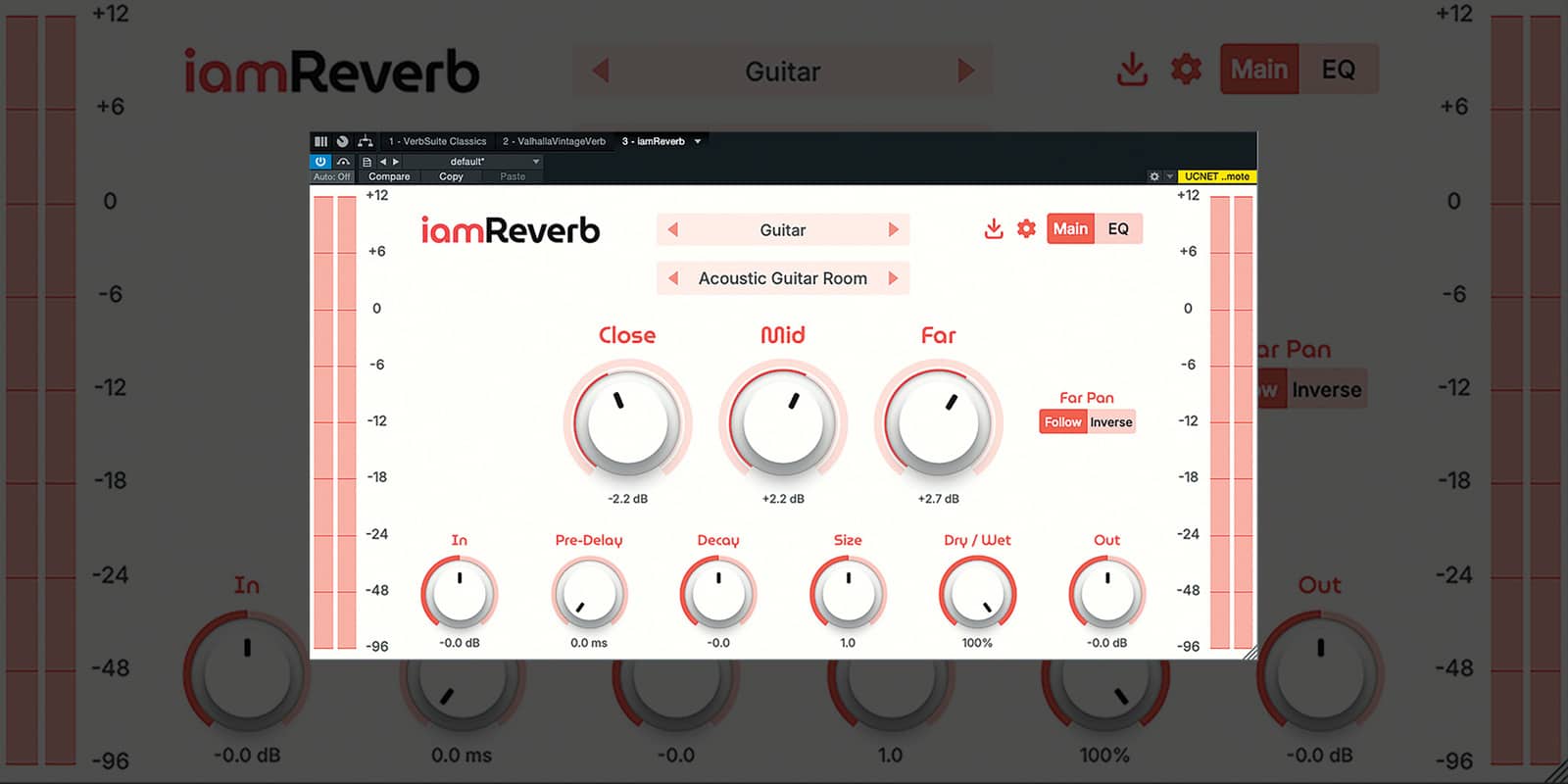
The plugin GUI features a modern, minimalist interface that goes a long way toward meeting the “easy” part of the mandate. The controls are simple and self-explanatory. The muted color scheme is also easy on the eyes—pleasant and unfatiguing.
The GUI has two views: Main and EQ. The Main view is framed by lively input and output monitors. The lower section of the Main display has six knobs to adjust typical reverb settings, including input and output levels, pre-delay, decay, size and wet/dry mix.
Control the Room
The big iamReverb innovation is on display in the center of the Main view, where you’ll find three large rotary knobs for setting the blend of Close, Mid and Far reflections. By altering the blend of these “distance” controls, you can add in perceived spatial cues from different positions in the room in a way I have not encountered in a reverb plugin thus far. Haloed level meters on the three knobs provide visual feedback.
Another unique feature is the Far Pan toggle, which inverts the stereo field of the Far reverb tail. When toggled in, it spreads the effect of mono and hard-panned sources more effectively across the sound field.
Spatial Options
If you are thinking, “That sounds pretty straightforward so far,” it is. In fact, if all you had was a single space to tweak with the above parameters, iamReverb would offer a unique take on reverb (convolution or otherwise).
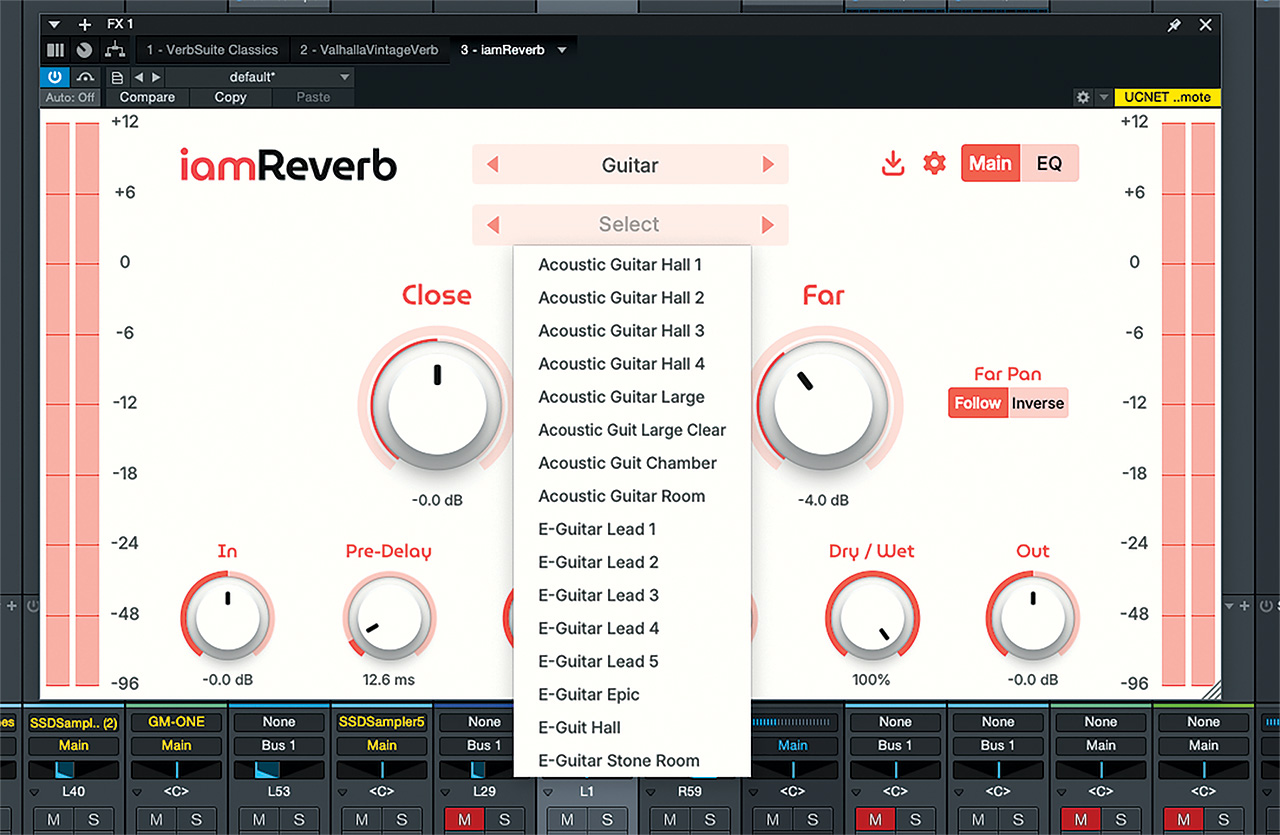
Luckily, the included 100 presets are built from impulse responses captured in 30 different actual spaces, which you can craft and blend to taste into an almost endless number of options. It’s worth noting that at this time, the iamReverb is all about
physical spaces—you will not find any mechanical (plate or spring), tape-based or algorithmic reverb options.
Shape Your Tone
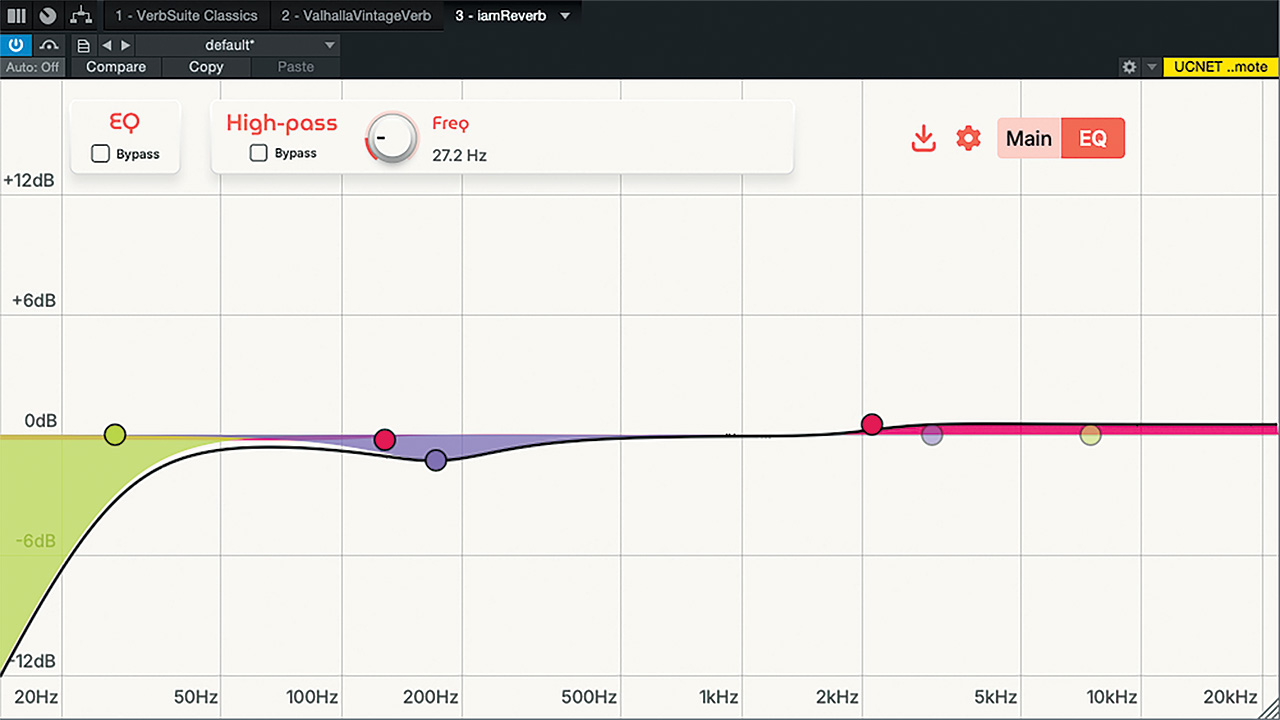
On a dedicated second page, you can tailor the effect further with a 6-band minimum phase equalizer found under the EQ tab. The bands include high and low-shelf filters, low- and high-pass -12dB/octave filters and a pair of peak filters with adjustable Q. The filters are only active on the wet signal.
It’s So Roomy
The iamReverb presets are organized by room type (hall, room, church and chamber) and by application (guitar, piano, strings and winds, synth and drums). You won’t find post-production and sound design-related presets—things like garages, bathrooms, bus stations, and the like—as you often do with convolution reverbs. This one is very music-forward.
And you won’t find very short decay ambiences in the presets, which I found a bit odd. But after playing with the plugin for a while, I realized the Close, Mid and Far blend controls made it very easy to dial in just about any type of ambience you might want or need.
Different Places in Space
Editor Paul Vnuk Jr., who has also been checking out the iamReverb plugin, pointed out a great technique for using the blend controls—open three instances of the plugin with a shared set of parameters. Then position your mix elements in the virtual room using various distance weights corresponding to where you want to situate them in the mix. Push background vocals with more Far reflections, pull guitars slightly forward with more Mid and put vocals upfront using more Close as an example. It’s cunningly effective. [Aw, thanks, Bill -Ed]
ERM
One of the knocks on convolution reverb is that it can often sound too diffuse because early reflections are blended with the tail, and close-captured impulse responses can be prone to phase and comb filtering. Enhanced Reverb Modeling (ERM) is the iamReverb answer to best capture impulse responses from a short distance without too much interference. They claim their technique results in crystal-clear early reflections and a tight and defined bass response.
My ears confirm the ERM. Simply put, this is a wonderful-sounding, practical room/hall reverb capable of situating instruments in the space in a natural, sonically attractive manner. I would equate all of this with the ERM process.
Early reflections are critical for artfully rendered small spaces. In use, I found drums and other live instruments sound quite cohesive in a shared physical space.
Larger spaces are equally attractive. The halls and chambers are lush without any sense of artificiality, which makes sense. No modulation is added to the tails, as is often the case with algorithmic reverbs.
This allows you to be quite liberal with the amount and mix of larger and longer reverbs you wish to add to your tracks. It bathes instruments and vocals in a generous ambience while retaining their distinction and focus.
Overall, the presets are spot-on in terms of their application, and the extensive ability to shape them to taste is well implemented. The EQ is a nice touch as well, as it is often a good idea to restrict the amount of high and low frequencies in the reverb tail.
Despite the purposeful simplicity of its looks and function, under the hood, iamReverb is positioned as a next-generation take on the convolution reverb paradigm, which is reflected in the price.
This Is Reverb
Hats off to iamReverb—the company and plugin—for crafting an adaptable, lively reverb with a high degree of believability. The sampled space’s character and acoustic performance are almost palpable. Again, this plugin just sounds like you have placed your sources in a great-sounding space. Shout out to the Acoustic Guitar Hall range of presets!
Price: $299
More From: iamreverb.com