

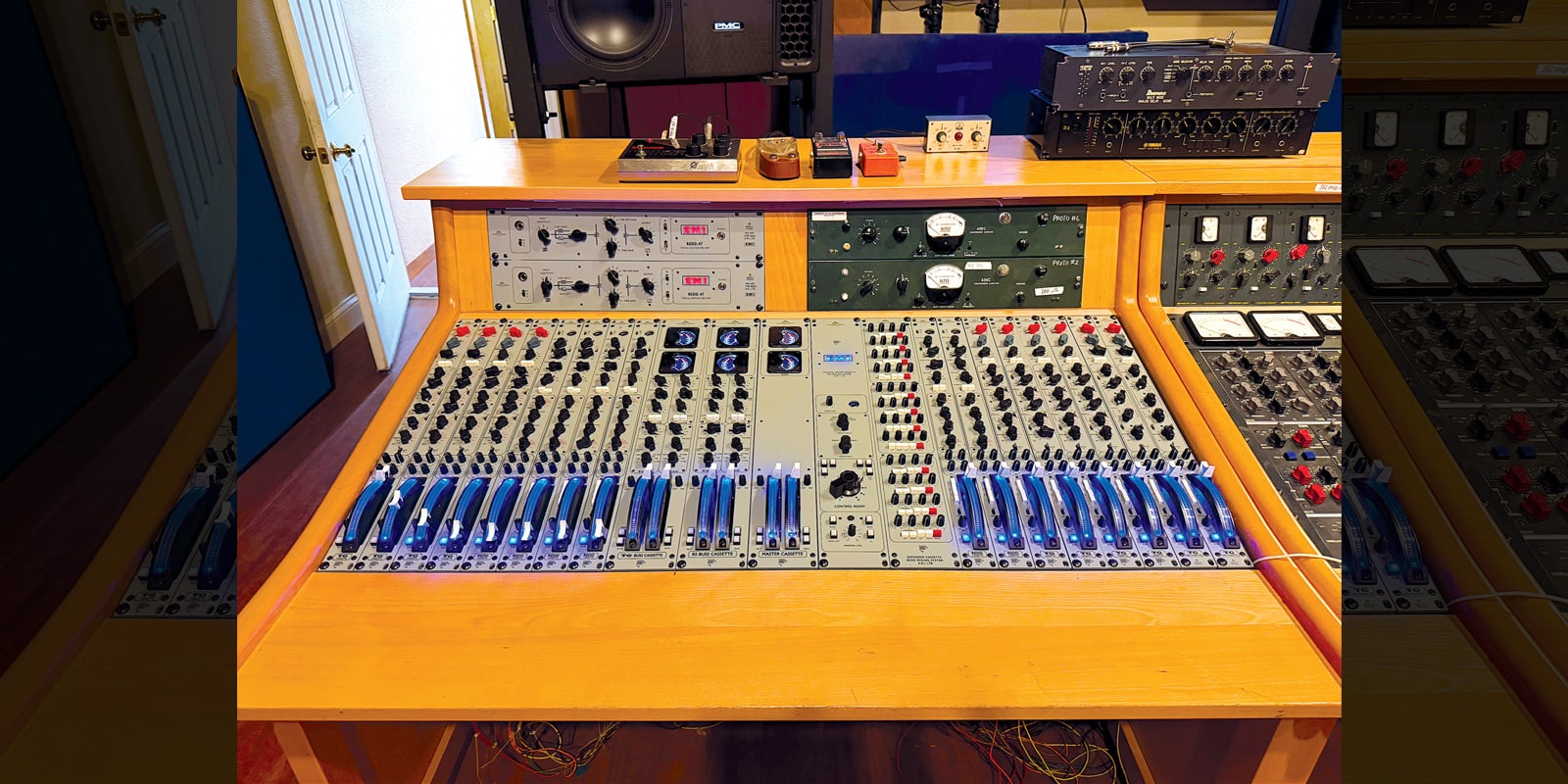
The mythological EMI mixing desk reborn!
Review by Paul Vnuk Jr.
Designed in partnership with Abbey Road Studios and EMI, the Chandler Limited REDD Mixing System continues the Iowa-based audio manufacturer’s 25-year history—which started with the EMI-based TG1 Limiter in 2001—of bringing classic EMI/Abbey Road audio designs into the modern world. This time, Chandler offers not one, but three classic EMI-designed console flavors in one modular and expandable recording and mixing system.
Past Featured Reviews
- October 2026: Chandler Limited REDD Mixing System
- September 2026: Barefoot Sound Footprint 01 Gen 02 and Footprint 02 Gen 02
- iamReverb
- August 2026: Focusrite ISA C8X
- July 2026: JZ Microphones MU-1
- Fender Quantum LT 16 USB-C Audio Interface
- LANDR: An all-in-one music ecosystem
- June 2026: Strymon NightSky Experimental Reverb Plugin
- May 2026: Sennheiser HD 480 PRO
The Record Engineering Development Department
From REDD to TG
Few pieces of gear stir the imagination like the curved-fader-equipped mixing desks found in the hallowed halls of Abbey Road Studios, seen largely in classic black-and-white photos of the Fab Four in action.
The EMI console lineage begins in 1955/1956 with the REDD.1, comprising the passive REDD.8 mixer connected to separate racks of amplifiers and electronics—an early mixing system, if you will. Note that REDD is short for Record Engineering Development Department which opened in 1955 to maintain, modify, design and build consoles and recording gear exclusively for EMI-owned studios.
Largely recognized as the first EMI mixing console, the REDD.17 was an eight-input, mono/stereo-out valve desk commissioned in 1958. It used Siemens V72 valve amplifiers and a simple 2-band EQ. Only four were made, one of which remains at Abbey Road.
Designed in 1958 and commissioned in 1960, the 8-in/4-out REDD.37 accommodated mono, stereo and 4-track recording, employing 31 V72 amplifiers. Its 2-band EQ modules could be swapped for “classic” or “pop” settings. Only three were made—one prototype and two production units—all now in private collections. The REDD.37 famously captured the first two Beatles albums, Please Please Me and most of With The Beatles.
In 1963, the REDD.51 replaced the REDD.37, exchanging the Siemens V72 for the EMI-designed REDD.47 valve amplifier, offering greater headroom, lower distortion and a punchier character. The 14-fader desk controlled eight microphone channels, two auxiliary inputs and four outputs while retaining the swappable classic/pop EQ.
The REDD.51 signature can be heard on Beatles albums from With The Beatles through 1968’s The Beatles, aka The White Album, as well as Pink Floyd’s The Piper at the Gates of Dawn. Only three REDD.51 desks were made and only one is known to survive today in fully restored form at Mark Knopfler’s British Grove Studios.
I also estimate that fewer than 150 REDD.47 amplifier modules were produced, so lucky for us, the REDD.47 microphone preamp was resurrected by Chandler Limited in 2015, followed by the REDD.47 Special Edition in 2025. I reviewed both in January 2015 and October 2025, respectively.
Solid-State
The advent of 8-track recording ushered in the EMI-developed, solid-state TG12345 Mk I console in 1968. This 24-by-8 desk comprised 12 modular microphone cassettes with two channels each, along with eight outputs. Each channel employed a germanium-based microphone preamp, expanded EQ and, cutting-edge for its day, a compressor. Most notably, the Mk I was responsible for the smoother, polished sound of The Beatles’ Abbey Road, followed by recordings including George Harrison’s All Things Must Pass, John Lennon’s “Instant Karma!” and Plastic Ono Band, and Paul McCartney’s “Maybe I’m Amazed.”
Subsequent Mk II, III and IV desks expanded the TG architecture for 16-track recording and increasingly sophisticated routing and monitoring. From the Mk II onward, the TG desks switched to Class A silicon transistors, which were more stable, cleaner and punchier than the germanium devices in the Mk I. Famously, a wraparound, quad-equipped TG12345 Mk IV was used for Pink Floyd’s The Dark Side of the Moon.
Only one Mk I desk was built and was later discarded after being donated to a school, although some modules survive at Abbey Road. Fourteen Mk II/Mk III desks were built from 1969–1971; one complete restored Mk III remains at Abbey Road. Two custom wraparound Mk IV desks were built in 1971 for Studios Two and Three, and both survive in private collections.
Note that the now equally classic Chandler Limited TG2 preamp, released in 2002, and subsequent iterations such as the TG2-500, reviewed in October 2014, and TG Microphone Cassette, reviewed in April 2017, are based on the Mk IV preamp architecture.
EMI console development ceased around 1974 as commercial name-brand offerings became commonplace. Fast-forward to the 2026 NAMM Show, and Wade Goeke and Chandler Limited have crafted the first official EMI/Abbey Road recording console in over 50 years.
The REDD Mixing System
You might be wondering, beyond a certain Beatles nostalgia, does the world need yet another high-ticket, boutique recording console? Here is where things get interesting and forward-thinking, and why this is called a mixing system rather than just a mixing desk.
The entire cassette-based system is fully modular—not just in the 500 Series or traditional bucket-by-bucket sense. Each of the three channel-strip cassettes can stand alone and be purchased à la carte for about the price of a typical boutique rackmount preamp or channel strip.
From there, you can grow and configure your system into a 2- to 8-channel sidecar, a full-fledged 8- to 16-channel mixing desk, a 4-channel tracking/16-channel summing mixer and beyond with optional task-focused cassettes. Better yet, there is no proprietary connectivity trickery. Connections are via XLR, 1/4” and D-Sub, and multiple cassettes can be daisy-chained from a single tube or solid-state PSU, respectively—sold separately.
Size Matters
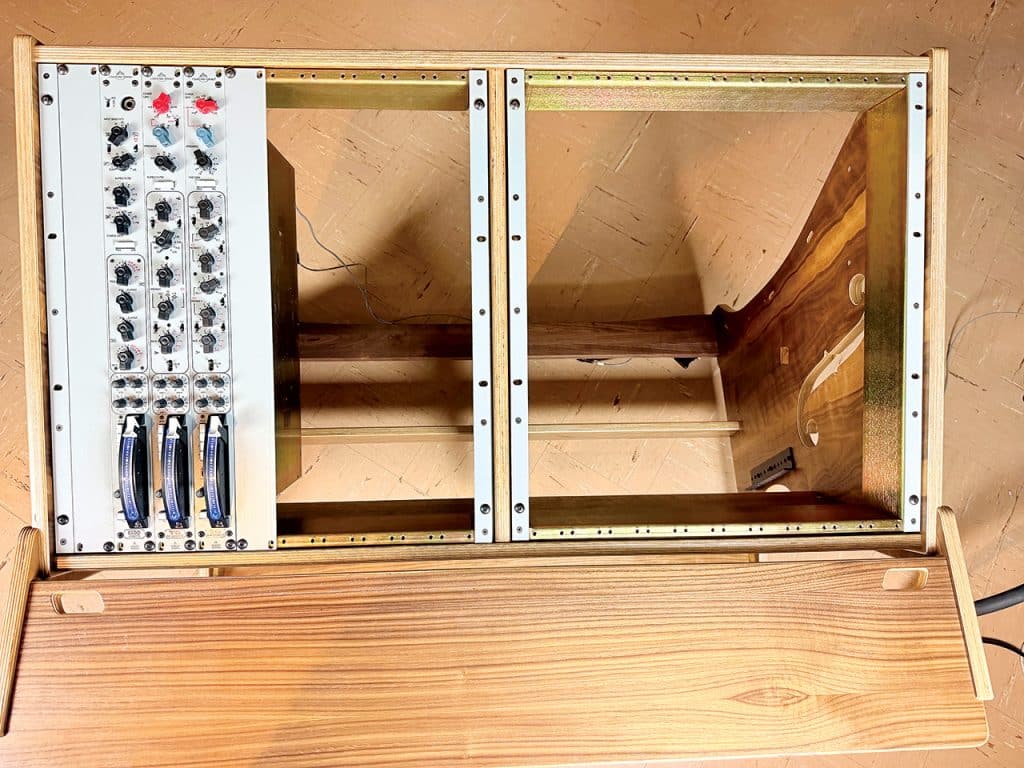
One thing to note is that despite being 1- and 2-U-sized modules, these are not 19″ rackmount devices. Rather, they are vertically oriented, with each module measuring 21″ in length, designed to fit most 19″ x 21″ (12-U-high) mastering-style desks or side racks using the REDD System Frame Kit.
A Collection of Cassettes
There are eight cassette offerings in the REDD Mixing System,
encompassing three input topologies, three buss options, a 12-channel expander and a dedicated control room section.
Input Cassettes
- REDD—Tube-based REDD.47 topology
- TG12345 Mk I—Germanium-based TG topology
- G12345 Mk IV—Class A silicon-based TG topology—I.E. TG2 amplifier stages
Buss Cassettes
- Master Buss—A 2-channel TG12345 Mk IV-based master buss
- TG Buss—A 2-channel buss based on the TG12345 Mk IV topology
- RS Buss—A 2-channel buss introducing a fourth EMI/Abbey Road topology: the tube-based RS61 two-stage amplifier circuit, augmented with TG-based technology
Utility Cassettes
- 12-Channel Expander—12 channels of TG12345 Mk IV line inputs
- Control Room—The only non-vintage-derived cassette in the system, built around a modern discrete op-amp design for ultra-clean monitoring
Famous Painton Quadrant Faders
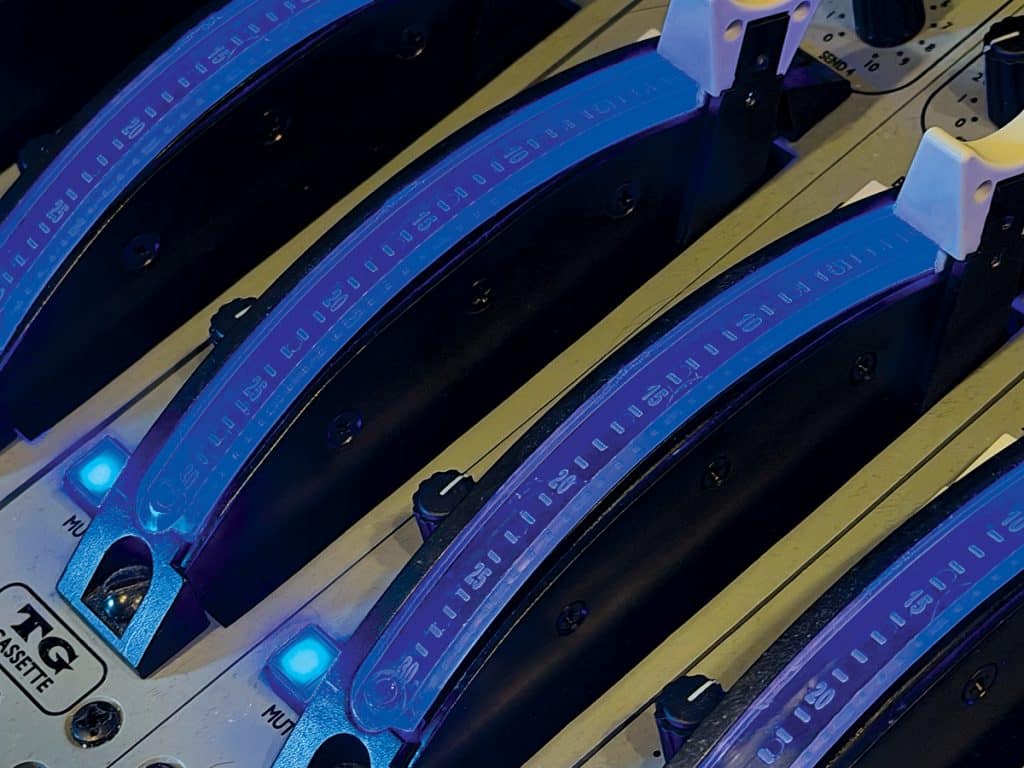
This is a great place to note that each Input Cassette and all three Buss Cassettes feature painstaking recreations—or better yet, significantly improved and more reliable versions—of the long-discontinued Painton Quadrant faders found on the original REDD and TG desks.
Each fader features a beautiful blue LED backlight, and each fader section has dedicated rear XLR-based patch points, giving you the flexibility to place the fader where needed in the signal chain or bypass it entirely for summing or DAW-based mixing scenarios—most commonly with a patchbay.
Connections and Flexibility
DB-25 connections handle buss and send routing, while most Input Cassette and fader audio connections are XLR, with 1/4” Low Level Inserts on the Buss Cassettes. A single Input Cassette can stand alone, multiple channels can feed two or four busses and sends, and Buss Cassettes can feed a stereo Master Buss and Control Room Cassette. Just as importantly, the system integrates easily with other mixers, preamps and outboard gear. It is one of the most flexible and configurable mixing desk systems I have encountered.
Input Cassettes
Each Input Cassette starts with a preamp section followed by EQ, aux/buss sends and the fader section. While similar in overall layout, each preamp and EQ differs according to its historic circuit design and topology. It’s also worth noting that each preamp and fader section employs individual input and output transformers.
Each channel offers mic/line operation, polarity reverse, 48V phantom power, four sends, four buss-routing buttons, a switchable pan pot, quadrant fader and blue-backlit Mute button. Wade notes that engaging the pan circuit slightly alters gain structure and sound through pan law.
One important note: while the original TG consoles were among the first recording desks in history to offer a simple three-control compressor on every channel, none of the current REDD Mixing System cassettes offer compression.
Wade cited two reasons: cost and size. A compressor of comparable quality would significantly increase the per-channel price, while the added circuitry would make each strip substantially longer and compromise compatibility with mastering-style desks and racks.
 REDD Input Cassette

The REDD Input Cassette is based on the REDD.47 mic preamp and the passive Classic and Pop EQ options found on the REDD.37 and REDD.51 consoles. Also onboard is Wade’s modern implementation of the 30 Hz to 180 Hz rumble filter found on the Chandler Limited REDD.47 preamp, along with the bass boost from the REDD.47 Special Edition and original REDD.51 console.
At the very top, the REDD Input Cassette is the only one of the three to include a 1/4” direct instrument input. Taken from the previous Chandler Limited REDD.47 preamps, this employs an EF86 tube stage similar to the input section of a classic Vox, Selmer or Watkins amplifier—a Wade Goeke signature touch.
The preamp architecture of each Input Cassette is central to the wide range of tonality available. On the REDD Input Cassette, it starts with an input sensitivity switch offering 0 to -20dB in 5dB steps, best thought of as an input pad. From there is a +/-10dB Fine Gain control and a +10 to +40dB Coarse Gain control.
The concept is simple: back off the Fine Gain and turn up the Coarse Gain for a cleaner, more open tonality, or crank the Fine Gain into the circuit and back down the Coarse Gain for boldness, thickness and even a bit of drive. Think of this as similar to a bias control. I can’t understate how big an effect these two controls have on the sound.
Moving to the EQ section, in addition to the rumble filter and bass boost, you have a simple 2-band +/-10dB Treble and Bass EQ that, as mentioned, can be set to the original Classic or Pop characteristics. On the original desks, changing between the two required an engineer to literally open the console and swap EQ modules. Here, it’s as simple as flipping a switch.
Better yet, unlike the original consoles, the REDD
Input Cassette lets you select Classic or Pop independently for each band, allowing you to mix and match the two characteristics. The original Classic EQ offered smooth, conventional shelving curves with an broad open tonal reach, with Bass and Treble turnover frequencies generally cited around 100 Hz and 10 kHz, respectively, while the Pop EQ offered a more aggressive, punchy response.
 TG Mk I Microphone Cassette

Taken from the first-generation, one-and-only TG12345 Mk I console, the TG Mk I Microphone Cassette marks the first time this 1968 germanium-based design has been made available to the general public. Interestingly, it features the simplest preamp structure of the three, with a single +10 to +50dB Coarse Gain control. Turning it up can once again yield a delicious range of tonal thickening and added harmonic content, although it is best paired with the output fader to keep levels under control.
An impedance control lets you select between a standard British Low impedance, a more common High U.S.A. standard, or line level. Next, the Mk I Cassette offers a selectable germanium-driven rumble filter with a choice of 30, 50, 70 or 90 Hz—a documented mod added to some of the Mk I Cassettes at a later date.
The EQ starts with the original Mk I 2-band low/high concept, augmented by a selectable Presence band derived from the original Group and Master cassettes, making this a 3-band EQ. Chandler Limited used original PCB artwork to recreate these and other circuits throughout the system.
Taking the EQ a step further, Wade has made the previously fixed Low and High shelving bands selectable between 60 or 110 Hz and 10 or 16 kHz, respectively. The Presence band offers +/-10dB across 300 Hz to 6.5 kHz in 11 steps, including Out.
Another modern touch lets you switch the shelving bands from their standard +/-10dB range to a much finer, mastering-style +/-2.5dB range. Perhaps even more unique, the Q and gain range of the Presence band can be switched between Narrow at +/-2.5dB, Mid at +/-5dB and Wide at +/-10dB.
In use, this has a profound effect on the EQ’s character, taking it from a broad, vintage-style tone shaper to a tool capable of subtly and tightly notching or emphasizing specific frequencies. Finally, as on each Input Cassette, the entire EQ section can be hard-bypassed.
 TG Mk IV Cassette

Now we come to the longest-standing design in the Chandler Limited universe, based on the final Mk IV TG circuit used in the MKIV recording and the TG12410 Mastering consoles. Once again, we begin with +10 to +50dB of Coarse Gain, followed by a choice of low or high impedance, or line level, similar to the Mk I.
When the original Chandler Limited TG2 was released, it made use of a single Coarse Gain control, similar to the Mk I Cassette. Here, however, the Mk IV Cassette forgoes the rumble filter in favor of separate Coarse and +/-10dB Fine Gain controls, as implemented on the Chandler Limited TG Microphone Cassette. Like the REDD Cassette, this allows for a range from super-clean to heavily colored input tones. Despite Class A silicon transistor architecture not typically being considered as flavorful as tube or germanium circuits, the TG Mk IV Cassette might offer the widest tonal range of the three preamp topologies.
The EQ section, while again rooted in TG-series origins, is a 4-band design based on the Curve Bender EQ architecture than the Mk IV desk EQ. Its Low (60 or 110 Hz) and High (10 or 16 kHz) shelving bands are similar to those on the TG Mk I Cassette, minus the +/-2.5dB option.
The two Presence bands offer +/-10dB of boost or cut across overlapping frequency ranges. Presence 1 offers Out, 800 Hz, 1.2, 1.8, 2.8, 3.6, 4.2, 6.5 and 8.1 kHz, while Presence 2 offers Out, 300, 400, 500 and 800 Hz, plus 1.2, 1.8, 2.8 and 3.8 kHz. Both offer a choice of a sharper +/-2.5dB setting or the standard +/-10dB Q, which here is not quite as wide as that of the TG Mk I Cassette.
 Buss Cassettes

To transition from standalone channel strips into mixing-desk territory, just add one or two Buss Cassettes.
There are two Buss Cassette offerings: the TG Buss Cassette and RS Buss Cassette, essentially updated takes on the Group Cassette architecture of the original TG12345 desks. Both are laid out identically and, like any good console, employ multiple stages of input and output transformers that collectively contribute to the sound.
The difference is topology. The TG Buss Cassette is built around Class A silicon architecture, while the RS Buss Cassette is tube-based, built around the lesser-known but hugely important RS61 valve amplifier.
Like the REDD.47, the valve-based RS61 was a general-purpose amplifier used throughout Abbey Road for passive filters, compressors, EQs and echo-chamber sends and returns.
In the excellent Recording The Beatles by Kevin Ryan and Brian Kehew (Curvebender Publishing, 2006), Abbey Road engineer Keith Slaughter called the RS61 “…the best valve amp ever,” while Brian Gibson recalled never having to service one, despite the amplifiers remaining in near-constant use for more than 20 years.
The primary difference between the TG Buss Cassette and RS Buss Cassette is their sonic signature—both when run clean and, perhaps more importantly, as you push them harder.
Moving from the top down, each Buss Cassette is a 2-channel affair—essentially stereo—with a pair of full-size, vintage-style left and right VU meters positioned one above the other to conserve space.
Below these is a pair of Send Master amplifiers corresponding to two of the four sends on each Input Cassette. Each Send Master offers three vitally important controls: Fine Gain (+/-10dB), five-stage Coarse Gain (1–5) and a master Output control labeled 0–10. Together, these let you control the summed level of the sends coming from multiple Input Cassettes, while also shaping their tone and character by varying how hard you drive each gain stage. Wade points out that, “I don’t know of any consoles that let you control the gain structure, gain boost and fine gain (bias) of the send and buss sections in the way ours do.”
Low Level Insert
Next, we need to highlight another Chandler-specific feature known as the Low Level Insert. On each Buss Cassette, this is represented by a pair of push buttons—one engages the insert, while the other flips its polarity.
Essentially, it is a built-in reamp and pedal insert circuit accessed via rear 1/4” I/O,
letting you send the Send Master through a guitar pedal, amp or both. Because it is a true insert before the send output, you can use both at once to do further creative things like inserting an analog delay pedal before a clean reverb and more.
While demoing the desk, we did some crazy stuff, sending a snare drum through a vintage Electro-Harmonix Memory Man on one buss and a vintage, miked-up Marshall guitar amp on a second, with both feeding an echo chamber. We tried it on vocals as well, and the results were creative and glorious in the mix.
The polarity button is useful for compensating for guitar pedals and other devices that may be wired out of phase.
NAB/IEC Buss EQ
Next in line is the Buss Amplifier, again with Fine and Coarse Gain controls similar to the Send Amplifier, performing much the same level and tonal-shaping role.
Rather than the original TG Presence EQ, Wade integrated the NAB/IEC EQ from the 1970s TG12410 Mastering Console. This 5-position preset EQ uses two sets of curves originally employed when mastering to analog tape: NAB in North America and Japan, and IEC/CCIR in Europe and Australia.
We first encountered a modified version of this circuit in the Chandler Limited TG Microphone (reviewed February 2019). Wade has long used an original in his own recording and mixing and considers it one of his favorite EMI devices, making it a natural fit here.
The five positions are split between two curves. Positions 1 and 2 use Curve 1 and are similar to engaging both the high and low REDD Pop EQ, at approximately +2 and +4dB, respectively. Positions 3 through 5 use Curve 2, more akin to the Classic EQ curve on the REDD Input Cassette, at approximately +1.5, +3 and +4.5dB.
Each Buss Cassette is rounded out by a pair of quadrant faders. Each channel also offers a push-button insert—for a compressor, EQ or other processor—complete with a Wet/Dry control. This is a very handy touch that eliminates complex routing for parallel compression or anytime you want to blend an effect into the buss. Finally, each channel has a dedicated Mute button.
 Master Cassette

The Master Cassette is designed to combine one or two Buss Cassettes into a final stereo output. It is the simplest cassette in the system, featuring a pair of VU meters and left/right master faders, each with the same Wet/Dry insert capability and Mute functions found on the Buss Cassettes. Note that the Master Cassette can also be used to combine a single REDD System Buss Cassette and the stereo outs of any other mixing desk, side car or summing box, expanding its use outside of the Chandler ecosystem.
12-Channel Expander Cassette
The 12-Channel Expander Cassette is a collection of 12 TG2-style/Mk IV amplifiers—essentially a 12-channel, TG-flavored line mixer. It can be used for keyboards, analog summing from a DAW, additional outboard preamps, line-level effects returns or any combination thereof. Once again, each channel employs its own input transformer.
The 12 channels are divided into three groups of four, each with its own set of send controls and buss-routing buttons. Rather than individual pan pots, each channel can be routed to the Buss Cassettes left, right or center, and each also has a dedicated Mute button.
 Control Room Cassette

The final member of the family, while vintage in appearance—complete with a glowing blue die-cut logo—is an entirely modern affair. It employs discrete op-amps designed to avoid coloration and remain as clean and low-distortion as possible.
A discrete headphone output is followed by three selectable speaker outputs. Note that Speaker 3 can be custom-wired to combine Speakers 1 and 2—for example, mains on 1, a sub on 2 and both together on 3.
The Monitor Select switch offers an impressive seven sources: Buss 1-2, Buss 3-4, Master Buss, External In, Send 1-2, Send 3-4 and Aux—talk about thorough monitoring options.
Next is the Control Room section. Master output level is handled by a 21-position, multilayer gold-contact Elma switch. There are also buttons for Mono, Polarity R (which flips the polarity of the right speaker), Dim and, one of my favorite features missing from far too many monitor controllers, individual Mute Left, Mute Right and Mute All buttons.
Finally, the Talkback section features a built-in electret microphone that can be routed to the busses, sends, main audio output or all of the above.
 Mixing with the System

For this review, I traveled to Shell Rock, IA, to experience a full-blown REDD Mixing System. Wade, his assistant Seth Luloff—instrumental in refining the new quadrant faders—and I tracked and listened to vocals, drums, guitars and bass through each Input Cassette and both Buss Cassettes, while also getting crazy and side-tracked with the Low Level Inserts.
Some of my general sonic observations were in line with my years of personal experience with four channels of TG2 and three channels of REDD.47 preamps. The REDD Input Cassette can offer incredible weight, richness and beautiful breakup and distortion when driven hard, yet it can also be set to sound remarkably clean, airy and full-fidelity—just a beautiful sound.
The TG Mk IV sound, while known for its smoothness and punch, offers perhaps the greatest tonal variance of the three, even more so than the standalone TG2, thanks to the addition and interaction of its Coarse and Fine Gain controls.
The big surprise for me was the TG Mk I. This deceptively simple germanium preamp can easily be more flavorful than the REDD, yet it too can be wonderfully smooth and polished like the TG Mk IV in a slightly more open way.
More importantly, and key to every great mixing desk, is what happens when these circuits become a complete system: tubes and/or transformers feeding more tubes and/or transformers, stage after stage. I was initially concerned about mixing all three topologies—which, given the system’s modular nature, you certainly don’t have to do—but it all comes together beautifully. Never once did I hear the different channel or buss topologies fighting one another.
I also have to draw attention to the balance Chandler Limited has achieved with the EQ sections. When desired, they can offer a classic, minimal vintage EQ experience, but there are enough modern refinements to make them far more versatile than simple broad-stroke tone shapers.
I was concerned that the quadrant faders might be more gimmicky than useful, but Wade and Seth have done a fantastic job not only recreating them, but, after side-by-side comparisons with original examples, improving them in every way from feel to function.
Have It Your Way
Of course, I spent much of my time mentally configuring my personal dream REDD Mixing System. Two channels of each TG Input Cassette and four REDD Input Cassettes would make a killer 8-channel sidecar. Add the 12-Channel Expander, both Buss Cassettes, Master Cassette and Control Room Cassette, and I would have a seriously capable tracking, mixing, summing and monitoring setup—albeit a significant investment.
Wade kept gently reminding me that I could simply start with a pair of TG Mk I Input Cassettes to augment the TG and REDD preamps I already own, then build from there as time, space and funds allow—which, once again, is the whole point of the system.
That said, it also made me realize that with even a modest yet full-fledged system like the one described above, I would no longer need an external analog summing box, monitor controller or racks full of external EQs and preamps.
Wrap Up
It’s hard not to be impressed by the Chandler Limited REDD Mixing System. It is easily the most ambitious undertaking Chandler Limited has embarked on to date, and quite frankly, Wade and his team knocked it out of the park.
Not only have they brought the classic sound of three sought-after EMI Abbey Road console topologies back to life, they have wrapped them in a thoroughly modern, modular system that brings the classic vintage mixing desk paradigm into the present. Better yet, its expandability lets the REDD Mixing System grow alongside your studio, making this more than simply a recreation of recording history—it is a system designed to keep that history working well into the future.
Price: Pricing for each cassette is available on the Chandler website and is 100% dependent on configuration
More From: chandlerlimited.com