

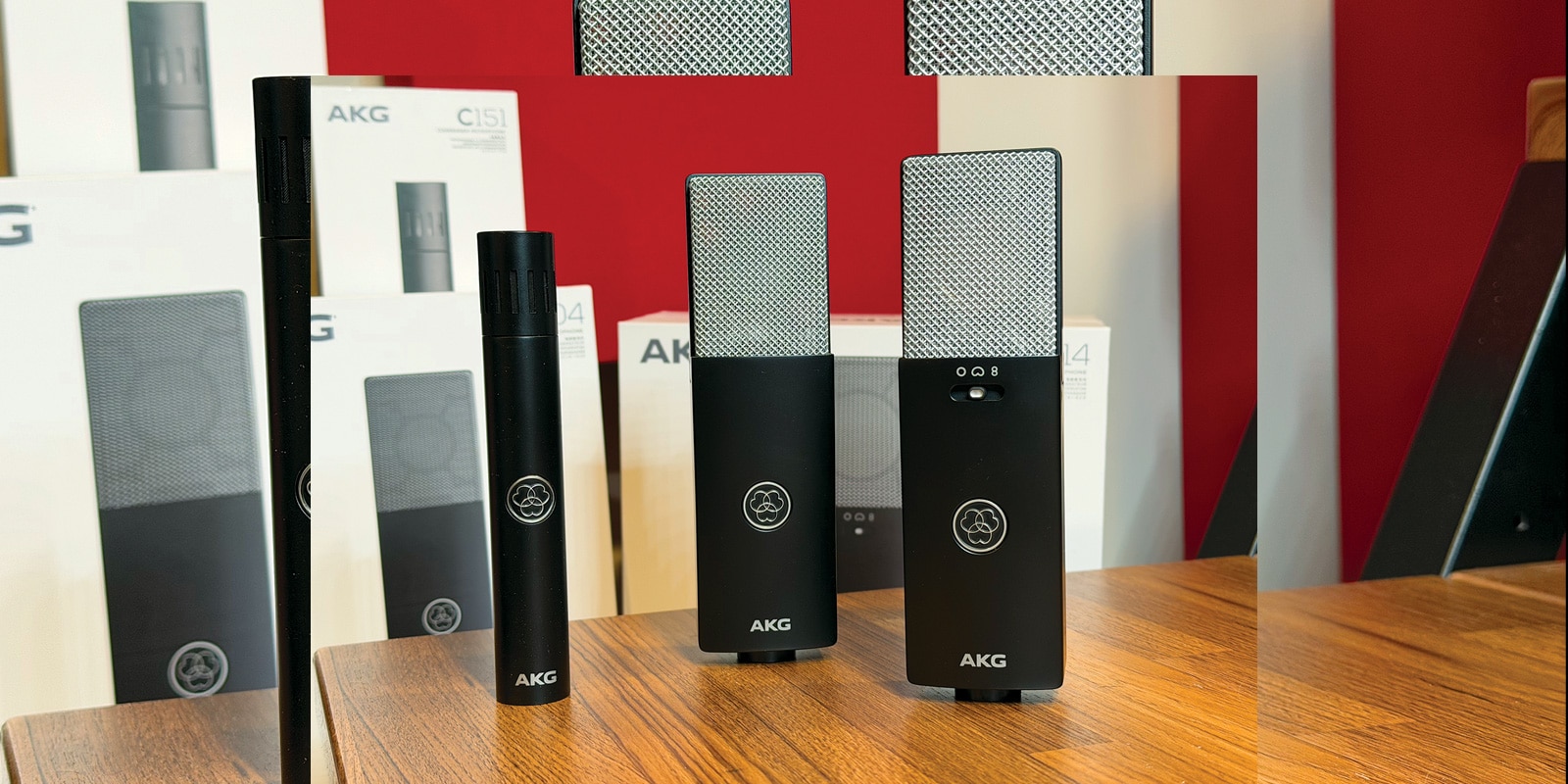
The Next Era of AKG Microphones
Review by Paul Vnuk Jr.
One year shy of its 80th anniversary, AKG introduces its first entirely new microphone models in close to two decades. The ultra-affordable large-diaphragm C104 and C114, and the small-diaphragm C151, are positioned as a new point of entry into the AKG universe.
The AKG Legacy
AKG stands among the most respected microphone manufacturers of all time. The C-Series, launched in 1949 with the now-iconic C12 tube condenser, remains a vital and influential presence in the audio production landscape more than seven decades later.
The solid-state C414, introduced in 1971, has become one of the most enduring studio microphones in history, with its various iterations remaining nearly ubiquitous in professional studios worldwide. In fact, during the 1970s and 1980s, the C414 was one of only a handful of professional, high-quality, solid-state, large-diaphragm condenser microphone options available. Then, as now, C414 models carried a decidedly professional price tag.
Reviews
- April 2026: IK Multimedia TONEX Plug
- March 2026: Magic Garden Pro Evolution v.1 Studio Monitor Package
- Kali Audio HP-1
- February 2026: AKG C104, C114 & C151
- REVIEW: Focal Trio6 ST6
- REVIEW: AKG C104, C114 & C151
- January 2026: Lauten Audio Kick Mic
- Imersiv D-1 DAC
- December 2025: Trinnov Nova
- November 2025: Solid State Logic SSL 18
The Path to Entry-Level
That landscape changed rapidly in the mid-1990s with the arrival of lower-cost condenser microphones manufactured overseas. The initial response from AKG was an expansion of the C-Series with more moderately priced models such as the C 1000 S, C 2000 B and C 3000. While more affordable than flagship offerings, these designs still occupied the $400 price range and were largely discontinued by the mid-2000s, with the exception of the C1000S and C3000.
Today, the C-Series includes the C414 XLII and XLS as solid-state flagships, alongside the tube-based C12 VR and the long-running C451 B pencil condenser. The line last expanded in 2009 with the introduction of the C214, followed by the C314 in 2015. Still, neither could reasonably be considered entry-level, leaving a clear gap between professional C-Series models and true entry-level options.
A more decisive move toward true entry-level offerings arrived in 2007 with the launch of the Perception line, later rebranded as the P Series. That series is now being phased out in favor of…
The New C-Series
…three new entry-level C-Series models: the large-diaphragm C104, the C114 and the small-diaphragm C151. Rather than rebranded or repackaged P Series designs, or cut-down ※lite” versions of existing C-Series models, each microphone is a fresh, ground-up design developed by Product Manager Phil Feinman and the AKG engineering team.
Each represents extensive research and development, with the goal of creating a new class of entry-level, great-sounding utility microphones suited to a wide range of recording applications.
A full-length interview with Feinman, along with a look and listen to all three microphones, is available on the RECORDING Magazine YouTube channel.
Sustainable Free Range Microphones
While that title may be a bit tongue-in-cheek, it is partially true, as these mics may be among the world’s first sustainable microphone designs. The microphone bodies are made from post-industrial recycled metal. Also, each mic’s packaging is printed with soy ink, while the internal bags, which appear plastic at first glance, are made from a corn-based material.
AKG C104
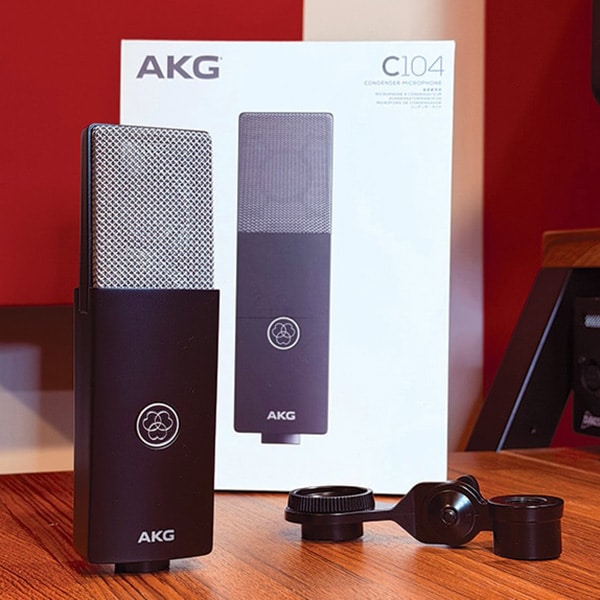
The lineup begins with the C104, a single-pattern, cardioid, side-address condenser microphone. While billed as a large-diaphragm mic, it is technically a medium-diaphragm mic, employing a 22 mm electret capsule with a single-sided, nickel-sputtered plastic diaphragm. Internally, the microphone uses a transformerless, surface-mount circuit design.
Visually, the C104 (and C114) leans harder into classic C414 styling than any previous C-Series model. At a glance, it could easily be mistaken for its more expensive sibling. The head basket closely mirrors the C414 in shape and bracing, although the body extends the full length of the microphone rather than terminating in a barrel-style connector.
The XLR connector screws directly into the included swivel hard mount, which accepts both 5/8” U.S. and 3/8” European mic stand threading, eliminating the need for pesky adapters. The satin-black finish used across all three models is understated, yet classy, with no pads, filters or switches.
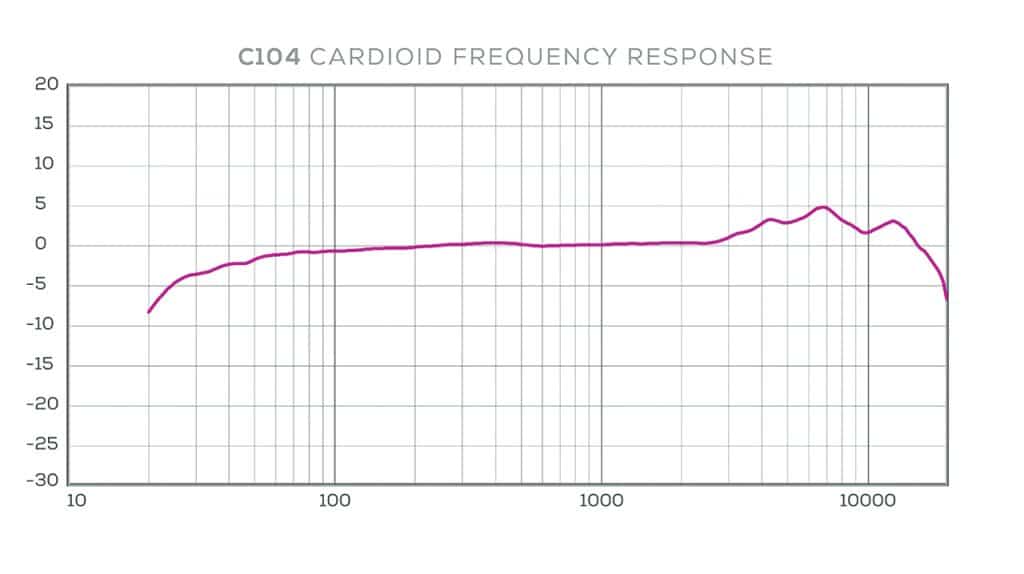
On paper, the frequency response suggests a modern, presence-forward condenser, but in practice the C104 proves more restrained in the high than many budget competitors. The top end is bright and open—arguably brighter than a C414 XLII—but remains free of brittleness. The magic of the C104 is its rich, well-behaved proximity effect, and even as distance increases, the low end stays firm and controlled, even out to roughly 1.5′. Additionally, the mic is respectively sensitive, a very quiet—especially considering its price class—and the off-axis rejection is super tight.
In Use
As an entry-focused utility microphone, I found the C104 worked well on both sung and spoken vocals—again the proximity effect is terrific here—rich and full without every being muddy or boomy. The C104 is also a great choice on stringed instruments such as acoustic guitar and mandolin. In these applications, a working distance of roughly 6″ to 1′ proved to be the sweet spot. The C104 also performed well on deeper and mid-toned percussion duties, including congas, shakers and djembe.
One delightful surprise was its performance on bass-heavy sources such as kick drum, the sound hole of a cajón (with a pop filter in place), and even bass cabinet, where it delivered a firm, controlled and focused low-end capture—not places I often use an inexpensive cardioid condenser.
On drum overheads, tambourine, and general room duties, the C104 did benefit from a small amount of post-EQ to slightly round off the top end.
The biggest surprise of all: the C104 carries a street price of just $129.
AKG C114
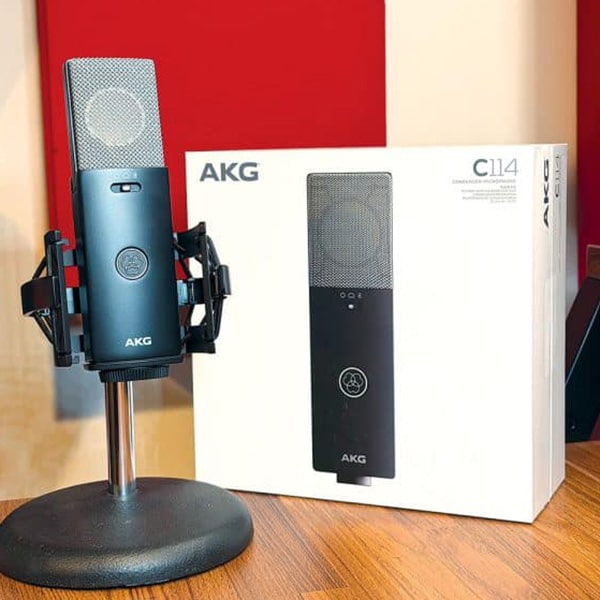
Moving up the ladder, the C114 is a multi-pattern large-diaphragm condenser offering omni, cardioid, and figure-8 polar patterns. While it does not use the same capsule found in the C414, the C114 employs a 26 mm, gold-sputtered, dual-diaphragm, edge-terminated capsule heavily inspired by the classic CK12 design.
It also employs a transformerless, surface-mount component design. Visually, the microphone uses the same body as the C104, but adds a three-position polar-pattern switch located just below the front grille.
Unlike the hard-mount-equipped C104, the C114 ships with a new, custom-designed open-front shock mount that screws directly into the socket on the bottom of the microphone.
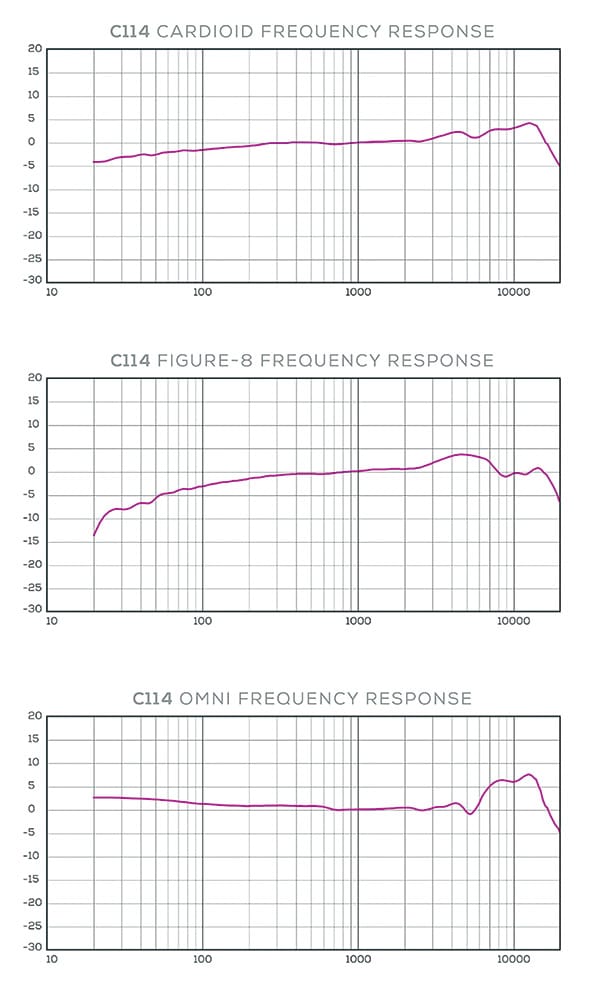
Looking at the frequency response in cardioid mode, the low end tapers a bit more gradually than on the C104, the upper-mid presence peak is more polite, and the high end is more extended. Switching to the other polar patterns yields expected results, with a bolder low end in figure-8 and a wider, more upper-mid–focused top end.
Omni mode is the brightest of the three, yet balanced by a surprisingly pronounced low-end boost.
In Use
Again, the C114 is billed as an all-around utility mic, and I could see it being a useful workhorse-style option in any mic locker from entry level to pro—seriously. I will make the bold claim that I would be comfortable using the C114 anywhere I would use a C414 XLII. While the C114 is not trying to be a C414 XLII, in cardioid mode its top end and mid range capture are more similar than they are different.
Interestingly, the proximity effect on the C114 is a bit more “normal” and perhaps a tad less rich than the C104, but that is splitting hairs. Its self-noise and sensitivity spec a few notches better than the C104. The C114 also has nice, tight off-axis rejection.
The more I use the C114, the more I appreciate it, whether on vocals, acoustic guitar, percussion or similar sources. I would have no hesitation using the C114 on its own or in matched pairs—something I highly recommend at this price—for drum overheads, room mic duties or positioned out in front of a drum kit.
Do I see the C114 as a C414 replacement? No. To be fair, the C414 XLS and XLII are higher-end designs and, by intent, better-sounding microphones. That said, while the C414 models cost roughly 600% more than the C114, the sonic gap is
nowhere near that wide. The design work here is impressive, and the C114 delivers a level of performance that easily supports a price double—or even triple—its current cost.
The only real nitpick I encountered was a small amount of noise when switching polar patterns–which happens in even more expensive mics as well.
The C114, at $229, is only $100 more than the C104.
AKG C151
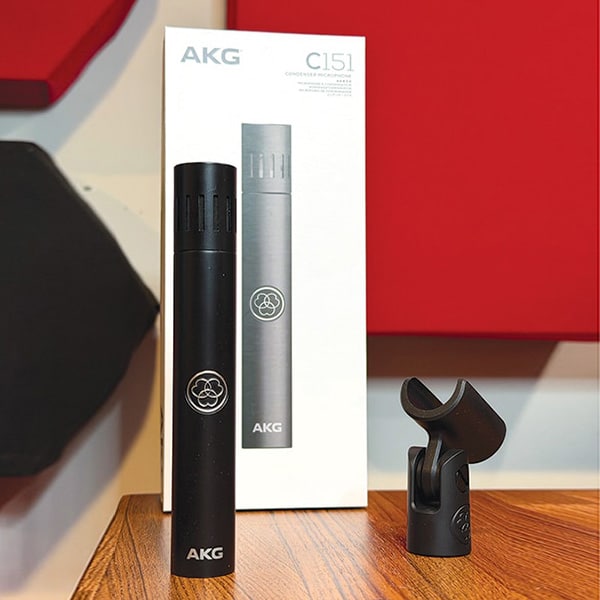
Finally, we come to the new entry-level pencil condenser in the line, the C151, with a name clearly inspired by the classic C 451 B—in my opinion, one of the two greatest pencil condensers of all time, particularly for most non-classical styles of music. The C151 is a cardioid electret design built around a 16 mm capsule housed in a standard 5.5″ (L) x 0.87″ (D) satin-black body.
Unlike the C 451 B, the C151 includes no pads, filters or switches. It ships with a straightforward but high-quality microphone clip that, like the hard and shock mounts supplied with its larger siblings, accepts both U.S. and European mic stand threading. Internally, the design follows the same philosophy as the rest of the new line: transformerless, surface-mount, simple and modern.
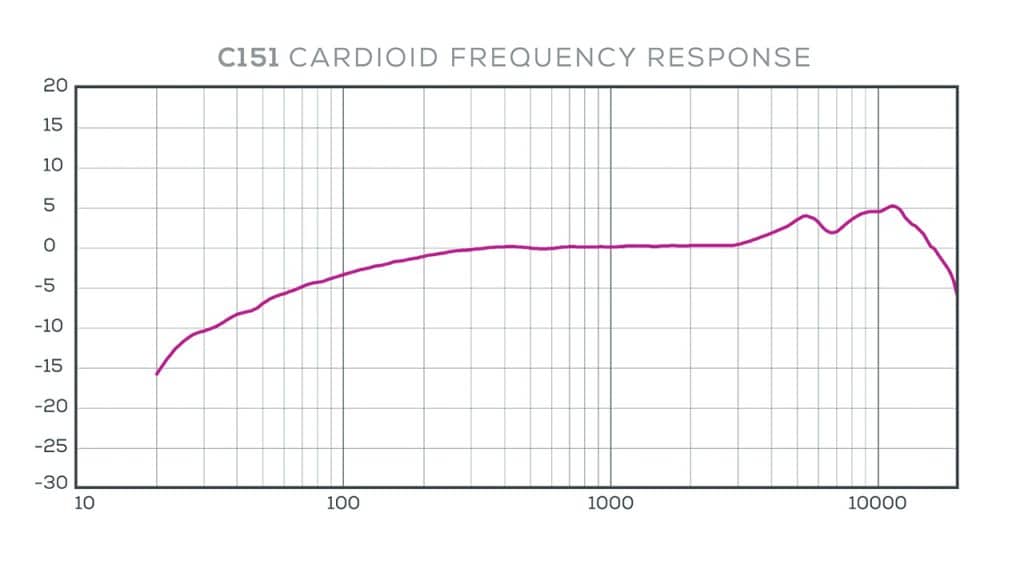
The C151 offers a tightly controlled, rolled-off low end paired with a distinctly forward top-end presence. Given its price and on-paper specs, I‘ll admit I was prepared to write it off as just another cheap, bright, thin pencil condenser—and I was completely wrong.
In Use
Spoiler alert—the C151 may be the sleeper of the line. While it is not attempting to be a lite, padless, filterless version of the roughly $749 C 451B, the C151 punches well above its weight class. It occupies surprisingly similar sonic territory, and in side-by-side comparison the C 451B comes across as the more laid-back and relaxed of the two, with the C151 acting as its more excitable younger sibling.
Yes, the C151 is brighter, with slightly less smooth weight, but it still excels in many of the same applications: drum overheads (perhaps with a touch of top-end EQ), acoustic guitar, mandolin, snare top and bottom, in front of a cajón, shakers, fiddle and more. With a good pop filter—often necessary, as most small-diaphragm condensers are prone to plosives—the C151 can even work well on vocals.
Like its electret sibling, the C104, the C151 offers a surprisingly musical proximity effect to exploit. Despite its cardioid-only design, it is also notably directional, especially up close, approaching hypercardioid behavior, and off-axis rejection is excellent.
At $129, this is one of the most killer entry-level pencil condensers I have heard in years.
Wrap Up
As a microphone collection grows, it becomes easy to grow jaded—and even skeptical—about entry-level offerings. Credit is due to Phil and the AKG design team for not only designing but executing a genuinely fantastic-sounding collection of microphones that does the C-Series legacy proud, especially without falling prey to the ongoing clone wars. I should also mention that each one is built like a tank!
The C104, C114 and C151 form a great-sounding, remarkably affordable and highly useful set of entry-level workhorse utility microphones, with some surprising uses and tricks up their sleeves.