

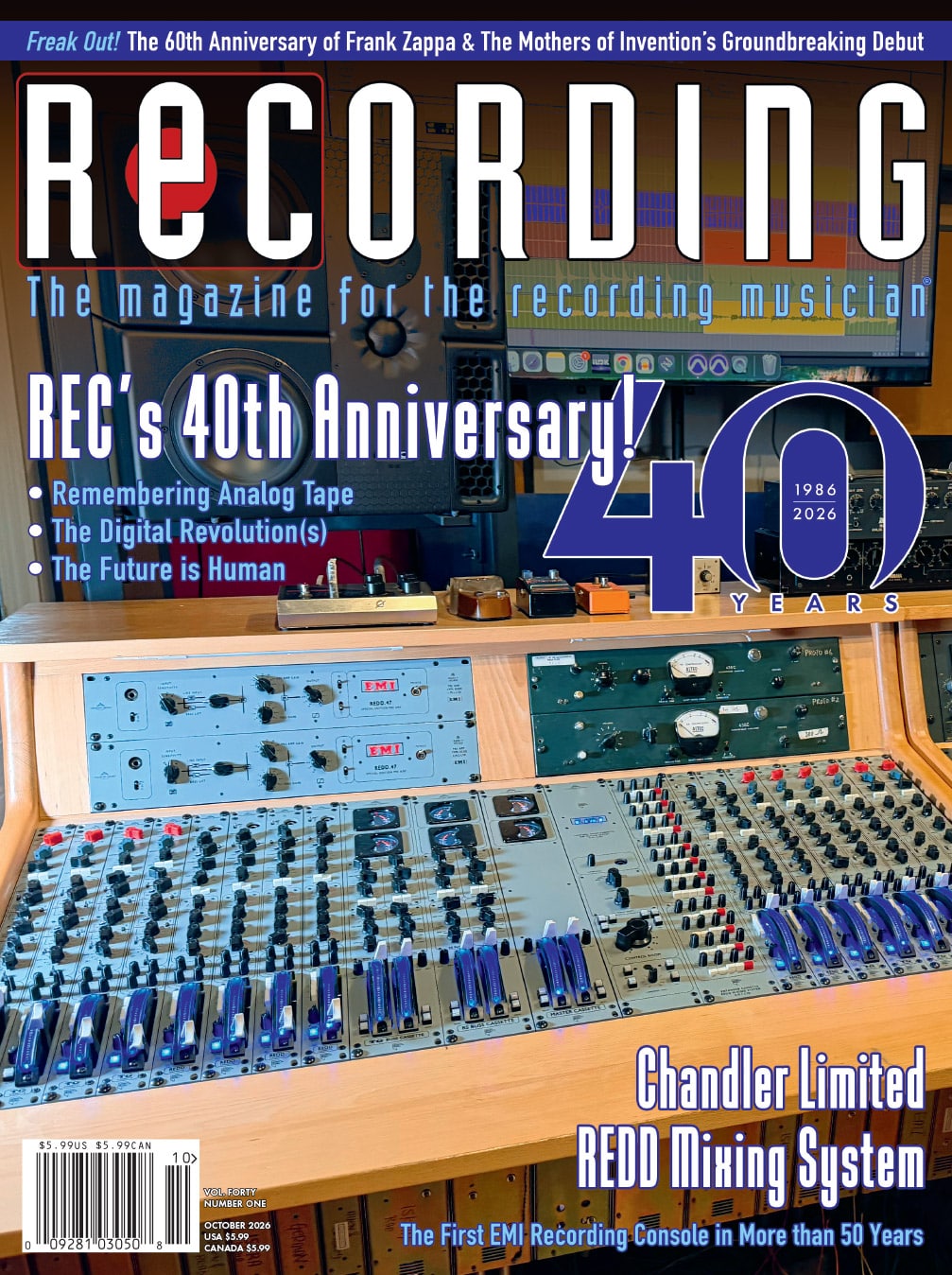
The Magazine
February 2010

Our February issue will give our readers something to sing about—we delve into the art and science of creating great vocals, with solid advice and great gear.
Our centerpiece article by well-respected engineer/producer Bruce Kaphan offers a wide and detailed look at vocal recording techniques; in our Vocal Column, Rick Barrio Dill offers insights on changing approaches to vocals and how a fresh start can lead to unexpected success. We also have reviews on voice-friendly gear like the Avant Electronics BV-1 tube mic and the PreSonus Studio Channel mic/DI channel strip.
But it’s not all about vocals: our Keyboard Column takes a look at building a studio to make best use of keyboards and sound modules, our Guitar Column takes another look at the signal chain of great guitar recordings.
Also in this issue, we review high-profile recording gear like Avid’s Digidesign Eleven Rack guitar interface, KRK’s Ergo tabletop interface and monitor/room tuning system, the TASCAM DR-100 professional field recorder, the MC Control from Euphonix’s Artist Series of controllers, and Camel Audio’s cool new softsynth Alchemy.
Your vocal track is the centerpiece of your song... learn to make it the best it can be with the February 2010 RECORDING!
Pick it up now on the newsstand... and so you get your next issue early (and save on cost), why not hit the big red Subscribe Now button on this page and have RECORDING delivered to your door each month?
Euphonix MC Control
|
Reviewed by
Darwin Grosse
Euphonix MC Control |
Reviewed by
Darwin Grosse
A world-class networking and control surface standard in a form any studio can afford.
Have you noticed a new trend in recording hardware? Some of the Great Names Of Recording, in addition to making large-format mixing conso......Expand
A world-class networking and control surface standard in a form any studio can afford.
Have you noticed a new trend in recording hardware? Some of the Great Names Of Recording, in addition to making large-format mixing consoles, are now creating recording tools specifically designed for the project studio. Why is that? It’s because the definition of a professional studio has completely changed. More CD releases, film scores and commercial tracks are being produced in home studios than ever before, and the demand for small-format, high-performance recording devices is massive.
Euphonix, maker of some of the most famous and expensive mixing consoles in the world, has now entered this market with its Artist Series of control surfaces for use with Apple computers. In an earlier article (February 2009) we examined the MC Mix control surface, which brought the high-end controls of a large-format console to bear against the compact world of DAWs. The centerpiece of the Artist Series is the MC Control, a transport/mix/control center unlike anything we’ve seen in the small studio environment....
Read more in the February 2010 issue of RECORDING!
Collapse
Avant Electronics BV-1
|
Reviewed by
Paul Vnuk Jr.
Avant Electronics BV-1 |
Reviewed by
Paul Vnuk Jr.
Not an imitator -- a new mic with impressive sound.
It has only been a few years since Avant Electronics (Avantone) slipped quietly onto the recording scene, but spend some time on the prominent gear forums and you will see ......Expand
Not an imitator -- a new mic with impressive sound.
It has only been a few years since Avant Electronics (Avantone) slipped quietly onto the recording scene, but spend some time on the prominent gear forums and you will see that many of their mics like their CV-12 have moved from general curiosity to high regard.
With this in mind I draw your attention to their newly minted B-series flagship, the BV-1...
Read more in the February 2010 issue of RECORDING!
Collapse
Avid Digidesign Eleven Rack
|
Reviewed by
Fernando Curiel
Avid Digidesign Eleven Rack |
Reviewed by
Fernando Curiel
A rackmount guitar interface that replaces an amp... AND a computer full of plug-ins?
Avid’s Digidesign Eleven Rack was not designed just with the contemporary guitarist in mind; producers, audio engineers and anyone interes......Expand
A rackmount guitar interface that replaces an amp... AND a computer full of plug-ins?
Avid’s Digidesign Eleven Rack was not designed just with the contemporary guitarist in mind; producers, audio engineers and anyone interested in digital recording and/or complete guitar rig emulations will also find many uses for it.
Eleven Rack is an 8-channel USB 2.0 high-resolution (up to 24-bit / 96 kHz) audio interface with two twin Texas Instruments chips running at about 300 MHz inside to handle the labor-intensive and delicately crafted emulations. It comes with a fully-featured (48 stereo tracks) version of Pro Tools LE 8 optimized for guitar players, which includes a dedicated Eleven Rack Window and more than 70 plug-ins, effects and virtual instruments.
Eleven Rack doubles as a standalone hardware unit (with no computer) that is rich in connectivity features for use as a centerpiece in a live rig. You are able to plug into the unit and send the output straight to a recording mixer, a live PA, a real amp, or to a physical speaker cabinet while bypassing the virtual cab emulation. Having one unit for all applications allows you to count on producing the exact tones on the road that you use in the studio....
Read more in the February 2010 issue of RECORDING!
Collapse
PreSonus Studio Channel
|
Reviewed by
Paul Vnuk Jr.
PreSonus Studio Channel |
Reviewed by
Paul Vnuk Jr.
When it's time to upgrade from your basic mixer inputs, check out this handy all-in-one rack.
For close to fifteen years PreSonus has been outfitting studios and musicians with gear that ranges from the budget to the boutiqu......Expand
When it's time to upgrade from your basic mixer inputs, check out this handy all-in-one rack.
For close to fifteen years PreSonus has been outfitting studios and musicians with gear that ranges from the budget to the boutique—computer interfaces, signal processors, monitor controllers, mic pres, mixers and more.
This month we look at the company’s newest creation: The Studio Channel. It’s a channel strip that starts with a Class-A vacuum tube microphone preamp and follows that with a VCA-based compressor and a 3-band equalizer....
Read more in the February 2010 issue of RECORDING!
Collapse
KRK ERGO System
|
Reviewed by
Paul Vnuk Jr.
KRK ERGO System |
Reviewed by
Paul Vnuk Jr.
Tabletop audio interface, monitor controller, and room acoustic correction—all in one.
You cue up some famous recordings you know well and listen closely; next you start mixing your own tracks while trying to get as close as......Expand
Tabletop audio interface, monitor controller, and room acoustic correction—all in one.
You cue up some famous recordings you know well and listen closely; next you start mixing your own tracks while trying to get as close as you can to those famous recordings. When you think you have nailed it, you take the fruits of your labor and audition them on computer speakers, a boom box, those little white ear buds, out in the car... something is not quite right, and so the process starts again.
If this sounds familiar, trust me, you are not alone. Many engineers craft their musical wares in less than ideal sonic surroundings such as bedrooms, dorm rooms, basements, garages, office spaces, and attics, and more often than not both translation and accuracy suffer.
While the first solution would, of course, be room treatments like bass traps and such, in many spaces this may not be possible, and in some rooms even proper treatment still can’t solve everything.
Is ERGO from the folks at KRK (the yellow cone speaker guys) the solution? Let’s find out....
Read more in the February 2010 issue of RECORDING!
Collapse
TASCAM DR-100
|
Reviewed by
Lorenz Rychner
TASCAM DR-100 |
Reviewed by
Lorenz Rychner
We reviewed its smaller siblings, now comes the top-of-the-line handheld recorder from TASCAM—very capable, very high-end, very practical.
TASCAM, a division of TEAC Corporation, has—in fairly quick succession—released three......Expand
We reviewed its smaller siblings, now comes the top-of-the-line handheld recorder from TASCAM—very capable, very high-end, very practical.
TASCAM, a division of TEAC Corporation, has—in fairly quick succession—released three handheld stereo recorders; we reviewed the DR-1 in July of 2008, the DR-07 in December of 2009, and here comes the DR-100. In what way are they different?
Read more in the February 2010 issue of RECORDING!
Collapse
Camel Audio Alchemy
|
Reviewed by
Mike Metlay
Camel Audio Alchemy |
Reviewed by
Mike Metlay
A power-packed sample playback and synthesis plug-in with a gorgeous sound.
Camel Audio is a British software firm that’s well known for its effects plug-ins and for a really fine additive/resampling software synthesizer cal......Expand
A power-packed sample playback and synthesis plug-in with a gorgeous sound.
Camel Audio is a British software firm that’s well known for its effects plug-ins and for a really fine additive/resampling software synthesizer called Cameleon 5000 (reviewed way back in March 2005). For a long time, Camel fans have wondered what would come after Cameleon 5000, which was a complex and expressive synth with lots of creative possibilities.
Several months ago, they got their answer: Alchemy, which takes and extends Cameleon 5000’s architecture in new directions and adds a huge palette of new synthesis features. It’s big and bad... is it beautiful? Let’s find out....
Read more in the February 2010 issue of RECORDING!
Collapse
Recording Lead Vocals—All About Isolation and Rejection
|
Written by
Bruce Kaphan
Recording Lead Vocals—All About Isolation and Rejection |
Written by
Bruce Kaphan
No, we’re not talking psychobabble... this article is all about getting your vocals right from the start, whether you’re recording a vocalist alone in an isolation booth or working to get the best rejection of sounds from other instruments as the ......Expand
No, we’re not talking psychobabble... this article is all about getting your vocals right from the start, whether you’re recording a vocalist alone in an isolation booth or working to get the best rejection of sounds from other instruments as the band plays together in the studio. All the wisdom you need for nailing the perfect vocal take is right here!
A day in the life of a recording engineer/producer is often filled with thoughts of isolation and rejection. That may seem sad. Fortunately, these thoughts rarely lead to aberrant behaviors, certain examples of interestingly hirsute producers notwithstanding. Seriously, though—isolation and rejection are two of many techniques an engineer can use to coax the best performances and the best sound from a session...
Read more in the February 2010 issue of RECORDING!
Collapse
RECORDING's Vocal Column
|
Written by
Rick Barrio Dill
RECORDING's Vocal Column |
Written by
Rick Barrio Dill
Sometimes, when you’re trying to get the best possible vocal take, it’s time to throw away the recipe book and live dangerously.
Decisions we make often come simply from habit. This is true for us as artists, engineers, prod......Expand
Sometimes, when you’re trying to get the best possible vocal take, it’s time to throw away the recipe book and live dangerously.
Decisions we make often come simply from habit. This is true for us as artists, engineers, producers, recording musicians, or just plain human beings. Natural instincts and intelligence tell us that once we do something successfully a certain way, all we have to do is repeat those steps and the same result will happen.
We can feel safe by working and living this way. Habit is a comfort food that we easily snack on, especially in situations where time is of the essence. As a result, this “safely going through the motions” can prevent us from making different decisions and using new methods, decisions and methods that could lead to a new and improved “alternative” for our art—and for our lives, for that matter. The way we go about recording vocals falls right into this category, at least for many of us....
Read more in the February 2010 issue of RECORDING!
Collapse
RECORDING's Keyboard Column
|
Written by
Devon Brent
RECORDING's Keyboard Column |
Written by
Devon Brent
We continue our look at designing the perfect keyboard-based studio, with words on rack mounting, cabling, and that mysterious and valuable beast, the patch bay.
In Part 1 (December 2009) we gave you a blueprint for incorpor......Expand
We continue our look at designing the perfect keyboard-based studio, with words on rack mounting, cabling, and that mysterious and valuable beast, the patch bay.
In Part 1 (December 2009) we gave you a blueprint for incorporating “real” synths into your studio, be they the keyboard versions that you play, or the keyboardless rackmount “modules” that you trigger remotely via MIDI. We talked about the practicalities of making space for the units and about the ergonomics of easy access. We listed a few representative examples of various synth types and their approximate values on the used market. We addressed the benefits of sequencing multiple MIDI parts on multitimbral synths, with or without separate audio outputs, and we came to the conclusion that you don’t necessarily have to spring for a new mixer just because you now have a bunch of new sound sources—you can record the synth parts one at a time while listening to all the sequenced parts at once.
Now let’s take a closer look at the signal flow and the connections....
Read more in the February 2010 issue of RECORDING!
Collapse
Fade Out
|
Written by
Mike Metlay
Fade Out |
Written by
Mike Metlay
It Starts With A Handshake.
As I write this, we’re looking forward to the upcoming NAMM Show, where a lot of you will be reading these words in copies of our magazine you’ve picked up on the show floor. This year my job of w......Expand
It Starts With A Handshake.
As I write this, we’re looking forward to the upcoming NAMM Show, where a lot of you will be reading these words in copies of our magazine you’ve picked up on the show floor. This year my job of writing a NAMM-relevant editorial has been made easy by a pair of companies who have decided to do something we don’t see often enough in the world of music technology: to shake hands....
Read more in the February 2010 issue of RECORDING!
Collapse